Farsoon FS4X: 99-litre LPBF platform for series production, with Stark Future as first buyer
Farsoon's four- or six-laser metal LPBF machine has a 425 × 425 × 550 mm envelope and AGV cylinder transfer; Stark Future is buying several for a series production line.
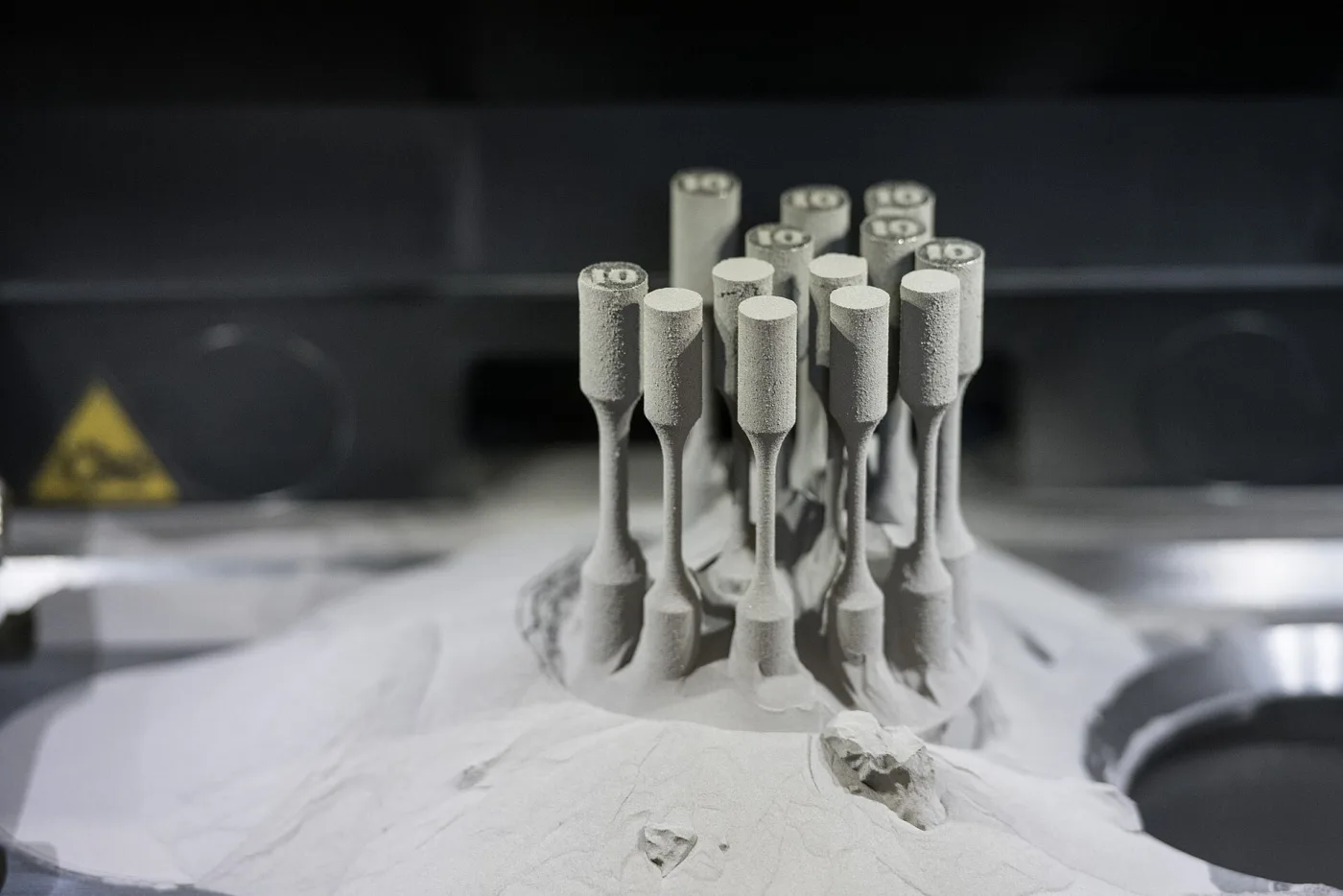
China's Farsoon introduced the FS4X on 12 November, a metal LPBF (laser powder bed fusion) platform aimed at series production. Its 425 × 425 × 550 mm build envelope, about 99 litres, comes with either four 2,000 W lasers or six 1,000 W lasers.
Metal LPBF vendors increasingly sell production cells rather than standalone machines, because buyers care about yield, downtime and cost per part. Farsoon is following that path, and the release says the FS4X brings together proven features from its earlier metal systems.
The machine belongs to Farsoon's CAMS automation portfolio. Build cylinders move by AGV, sealed and under inert gas, so cooling and depowdering happen off the machine, and job changes are automatic, allowing production to run beyond a staffed shift. A separate Powder Handling System handles powder recovery, sieving and conveying.
Farsoon says process stability comes from automated scanner calibration, multi-laser alignment, multi-layer gas flow and chamber pressure control. A one-piece machined build cylinder reduces powder leakage, linear-encoder feedback gives closed-loop Z-axis control, and the recoater blade can be changed through a dedicated airlock.
The first named buyer is electric motorcycle maker Stark Future, which agreed on 17 November, the first day of Formnext, to buy multiple FS4X systems for a series production line. Neither the number of machines nor the value was disclosed. The two companies have worked together since 2024; according to the release, a joint project validated repeatable titanium production across more than 1,000 parts.
"With metal 3D printing Stark is able to build higher performance vehicles," said Anton Wass, founder and CEO of Stark Future, adding that the process cuts weight by 50% in many cases. Oliver Huizhi Li, managing director of Farsoon Europe, said the shared goal is to make metal AM a practical alternative to conventional manufacturing on quality, repeatability, productivity and cost.
At Formnext, Farsoon Europe showed the FS4X only on video; the machine itself is installed at the company's European Innovation Center. No price, delivery date or qualified material list has been published.
The FS4X is another step by Chinese LPBF makers toward cell-level automation, and the Stark Future order gives it a real industrial application. How competitive it is will be shown by yield and repeatability data from the first installations, for which there are no public figures yet.