Nidec demonstrates a learning DED controller on the LAMDA500
The camera-driven system adjusts laser power and travel speed; two vendor trials do not yet qualify a part.
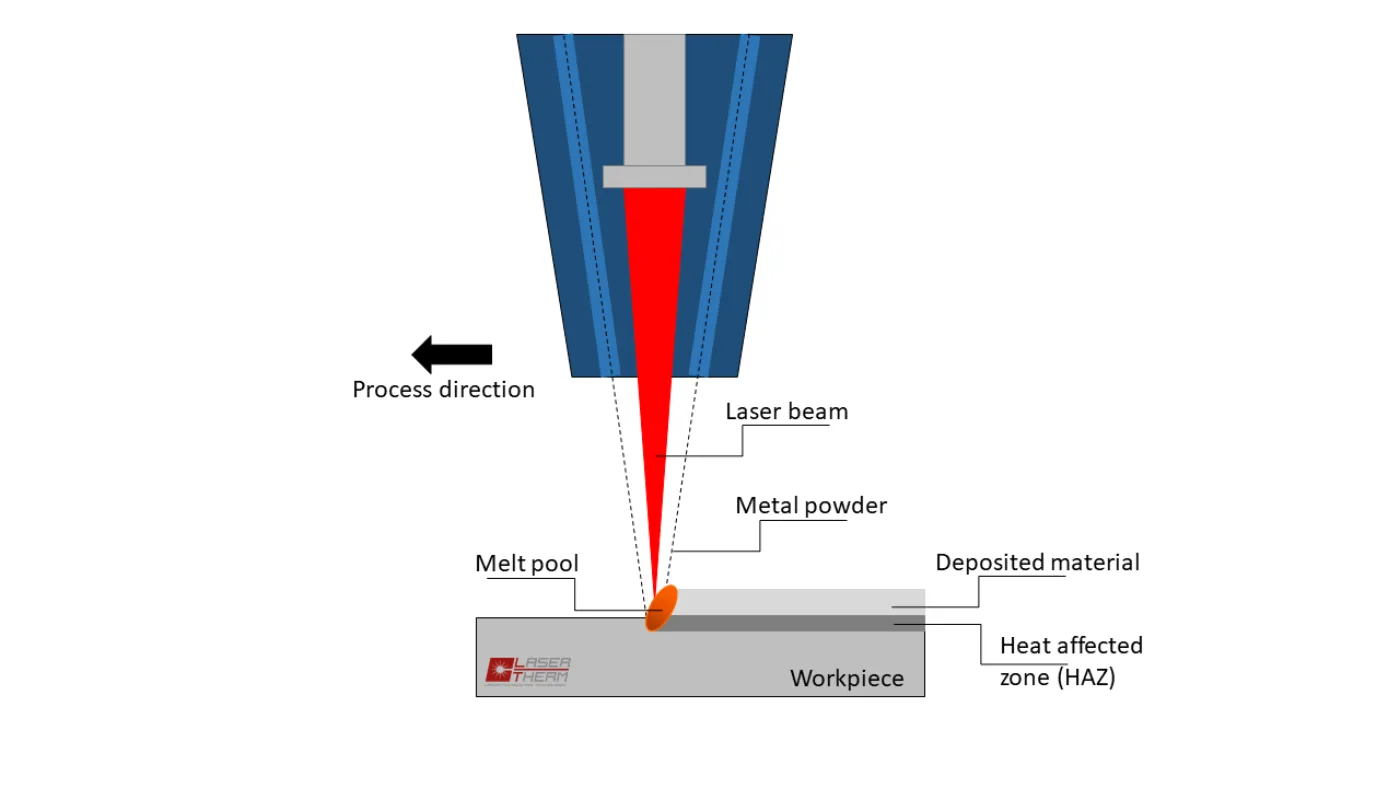
Nidec Machine Tool has announced an autonomous learning-based automatic controller for its LAMDA laser powder directed-energy-deposition systems. Public demonstrations begin on a LAMDA500 on 26 October, the opening day of JIMTOF 2026. The patent-pending system uses images from a coaxial camera to estimate process state and adjusts both laser power and head travel speed in real time.
The announcement date, demonstration, manipulated variables and vendor-described experiment are verified. Nidec claims the algorithm learns suitable control during the build without a large pre-trained dataset. Independent replication, raw time series, material-characterisation results and a production reference are not public.
What the system observes
A coaxial camera views the melt pool along the deposition head's optical axis. Nidec says image brightness correlates with melt-pool temperature and working distance, providing feedback with which the controller can react to changing heat input and deposited geometry.
Camera intensity is not automatically a traceable temperature measurement. Emissivity, alloy, surface, plume, powder stream, spatter, window contamination, exposure and geometry can all change the signal. The relationship between brightness, temperature and height therefore needs calibration for each material, optical configuration and operating window.
How learning control differs
Open-loop DED applies predefined laser power, speed and feed. It is simple, but accumulated heat, corners, intersections and changing heat flow alter the real process state. A PID controller corrects error from a setpoint, but nonlinear dynamics and varying delay demand careful tuning.
Nidec says its controller learns the process response during operation and selects laser power and travel speed accordingly. In principle this can reduce manual PID tuning and the need for a large prior dataset. The release does not identify the algorithm, update rate, latency, objective function or how unsafe exploratory actions are prevented.
What the maraging-steel trial showed
The vendor built two maraging-steel geometries: a 40 mm wide, single-bead wall 50 mm high, and a crossing of two 30 × 30 mm walls, also 50 mm high. Its comparison indicates that constant parameters and conventional PID control missed the target through heat accumulation, height error or instability, whereas the new controller completed both builds.
This is a useful control demonstration but narrow evidence. Replicate count, reference-metrology uncertainty, bead-width and height distributions, density, cracks, microstructure, hardness, tensile strength and fatigue are not disclosed. A completed wall is not yet a qualified part.
Safety bounds and fallback
The release describes output limits: learning control may act only within predefined laser-power and speed ranges. Bounds are essential because exploration must not enter regimes that cause lack of fusion, excessive dilution, keyholing or machine risk. Production also needs supervision for sensor faults, dropped frames, dirty optics, latency and communication loss, plus a documented safe fallback state.
Controller outputs and internal state should be time-stamped. The manufacturing record needs sensor and algorithm versions, calibration, bounds, every intervention, alarm and manual override. Otherwise adaptation cannot be reconstructed after the build.
Evidence still needed for production
The next step is a comparison across materials and geometries with at least three repetitions. Open loop, a well-tuned PID and learning control should run on the same machine, powder, path and environment. Evaluation needs geometry plus CT or metallography, chemistry, dilution, microstructure, hardness and mechanical properties.
Out-of-distribution conditions deserve separate tests: abrupt heat-sink changes, powder-flow deviation, camera obscuration, restart and partial sensor failure. Success is not intervention at all costs; it is recognising when evidence is insufficient to continue.
Editorial conclusion
Nidec is addressing a genuine DED problem: fixed parameters cannot fully track thermal and geometric change through a build. Two experimental geometries justify serious attention to the adaptive approach, but they do not prove general quality improvement or autonomous part release. Repeatable geometry and material-property data, calibrated sensing and documented fault handling are the next decisive evidence.
Sources
- Nidec Machine Tool: LAMDA Series metal 3D printers with newly developed Autonomous Learning-Based Automatic Control System — primary company technical release, 21 October 2026; public demonstration from 26 October 2026.
- NIST: Real-Time Monitoring and Control of Additive Manufacturing Processes — independent measurement-science context for the signal–process–quality chain.
- Smoqi et al., Materials & Design 215 (2022), 110508 — peer-reviewed comparison of closed-loop DED temperature control.