Validating patient-specific surgical guides from imaging to the operating room
A risk-based plan for imaging, segmentation, file integrity, fit, printing, sterilization and per-patient release.
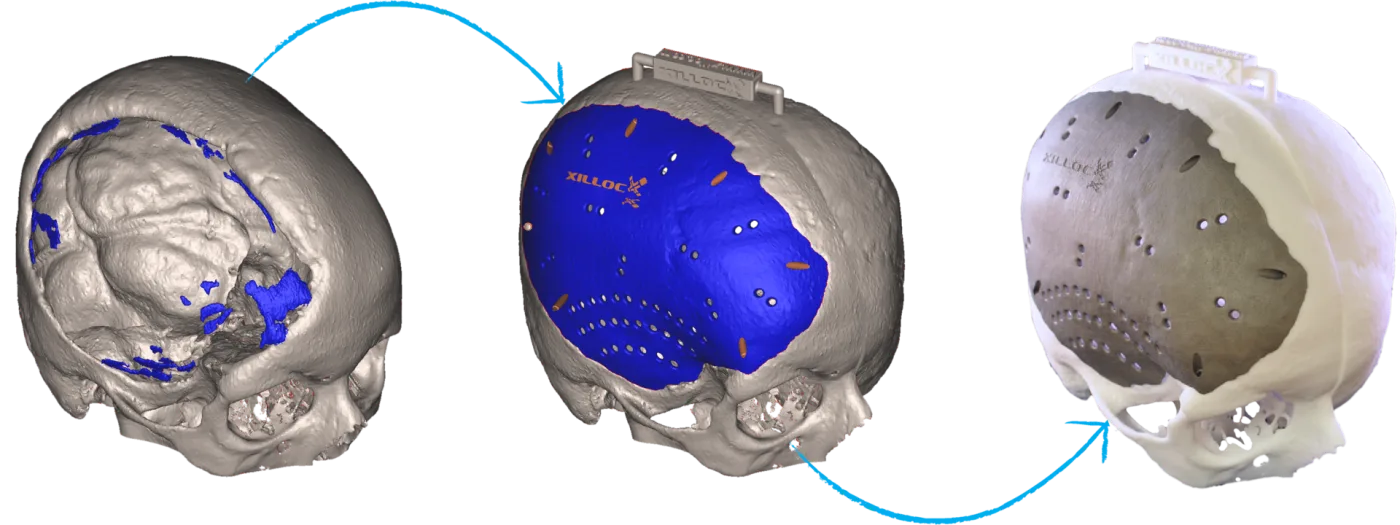
A patient-specific surgical guide is not merely an accurate 3D print. It is part of a clinical decision chain from imaging to the operating room, where a coordinate, segmentation, file-conversion, fit or sterilization error can direct an instrument to the wrong location. Validation must therefore cover the complete version-controlled workflow, not only printer repeatability.
1. Define intended use and boundaries
State what the guide controls: drill axis, resection plane, implant position, surface marking or a multi-point spatial relationship. Define anatomy, user, tissue contact, contact duration, sterile state and patient population. A patient-matched device is not automatically a custom-device exemption; FDA also evaluates predefined minimum and maximum design envelopes.
Risk-derived requirements
Tolerance must come from clinical hazard. The question is not whether a printer achieves 100 micrometres, but how the total angular, depth or translation error affects clearance from critical anatomy. A requirements matrix links hazard, design input, verification method, acceptance limit and release record.
2. Imaging is the first measurement system
CT or MRI slice thickness, voxel size, reconstruction kernel, motion, metal artefact and calibration bound downstream accuracy. Lock protocols by anatomy and verify scale and distortion with phantoms. Research-quality imaging may not be reproducible in emergency or multi-site routine use.
Time between acquisition and surgery is a separate risk. FDA's 2017 AM guidance notes that anatomy can change with disease progression, so image validity may need to appear in device expiry. The limit is clinical and anatomy-specific, not one universal number.
3. Segmentation and design
Validate segmentation on intended-population extremes: low contrast, small structures, implants, deformity and partial field of view. Record automatic and manual steps, operator authorization, software version, thresholds and approver.
Envelopes and internal checks
Design software should prevent wall, sleeve, angle or size values outside the approved envelope. FDA also recommends identifying the design iteration and devices with which manipulation software is validated. Clinical review and software constraints complement rather than replace each other.
4. Coordinate systems and conversions
DICOM, masks, meshes, CAD, slicers and machine files can use different coordinates, units and mappings. Patient-specific workflows repeat conversions for every case, creating a new integrity risk each time. Automated checks should cover patient identity, laterality, units, orientation, mirroring, scale, mesh integrity and hashes.
The final production package must trace back to source imaging, approved segmentation, design version, guide version, manufacturing lot and releasing person. Screenshots are not an audit trail; structured, time-stamped, access-controlled records are.
5. Fit and guidance error
Separate how the guide fits anatomy from where it directs after seating. A small local fit error can become a large angular error at the end of a long drill. Measure contact-surface deviation, rocking, reseating repeatability, axis angle and target-point translation.
Worst-case samples
Include minimum and maximum sizes, thinnest walls, sharpest curves, worst support orientation, longest instrument lever arm and least distinctive seating surface. Average geometry can conceal a flexible or ambiguously seated extreme.
6. Material, printing and post-processing
Approve resin or polymer for contact type, sterilization and mechanical load. Verify identity, expiry, storage and relevant viscosity or moisture by lot. Machine, orientation, layer thickness, supports, washing, drying and post-cure together form the approved recipe.
IQ/OQ/PQ logic is useful: IQ establishes installation and environment, OQ the parameter window, and PQ routine capability across lots and operators. Dimensional release needs calibrated measurement and known uncertainty; printer self-checks are insufficient.
7. Cleaning, biocompatibility and sterilization
Support residue, tacky resin and inaccessible cavities create cleanliness and biological hazards. Cleaning specifications cover time, solvent condition, replacement limits, access and residue verification. Biocompatibility applies to the finished, processed and potentially sterilized device, not only a resin datasheet.
Sterilization may change dimensions, stiffness, transparency or fracture behaviour. Validate the selected steam, gas or radiation cycle with packaging, maximum load and shelf life. For a guide entering the surgical field, cleaning and sterilization carry the same weight as geometry.
8. Clinical and usability validation
A gloved surgeon must recognize laterality, orientation and complete seating under limited visibility, fluid and soft tissue. Usability testing should deliberately search for falsely stable seating, excessive insertion force, misunderstood markings and tool–sleeve play.
Prespecify clinical endpoints such as position error, positive margin, reoperation, time or complications, and distinguish non-inferiority from superiority. Cairn's 418-patient randomized trial is instructive: BCL produced 14.4% positive margins versus 21.1% for wire localization, while superiority required nuanced interpretation of the prespecified threshold.
9. Per-patient release
Every guide needs a checklist: correct patient, side and procedure; valid imaging; approved segmentation; geometry within design limits; file integrity; approved machine, material and recipe; completed cleaning and sterilization; final visual and dimensional inspection; label and expiry. Independent checks are justified at the highest-consequence steps.
After a deviation, do not simply reprint the same bad data. Determine whether the cause is imaging, design, file, machine, material or post-processing, then repeat release with full traceability.
10. Change control and surveillance
Software updates, imaging protocols, resin, printer, slicer, supports, washer, cure unit or sterilizer changes require impact analysis. The response may be documentation, partial regression or full revalidation according to patient risk and the altered failure chain.
Routine indicators include design rework, manufacturing scrap, fit deviations, operating-room rejection, use error, complaints, clinical endpoints and recalls. Rare severe deviations must not disappear inside an average success rate.
Editorial checklist
A patient-specific guide is validated when use and envelopes are defined; imaging and segmentation are measurable; coordinates and files preserve integrity; worst-case fit and guidance error pass; the manufacturing recipe is capable; finished-device cleaning, biocompatibility and sterilization are demonstrated; usability and clinical endpoints are adequate; every case is traceable; and changes are controlled.
Sources and transparency
The framework draws on FDA's 2017 AM-device guidance, its 2026 patient-matched orthopedic-guide guidance, FDA's medical-AM overview and ISO 5092:2025 scope. The 2026 randomized BCL trial supplies the clinical example. This is quality-system background, not patient-specific medical advice.