FFF workshop air quality: measuring emissions and validating controls
A practical plan for ultrafine particles, PM, VOCs and microplastics with background samples, repeats and change control.
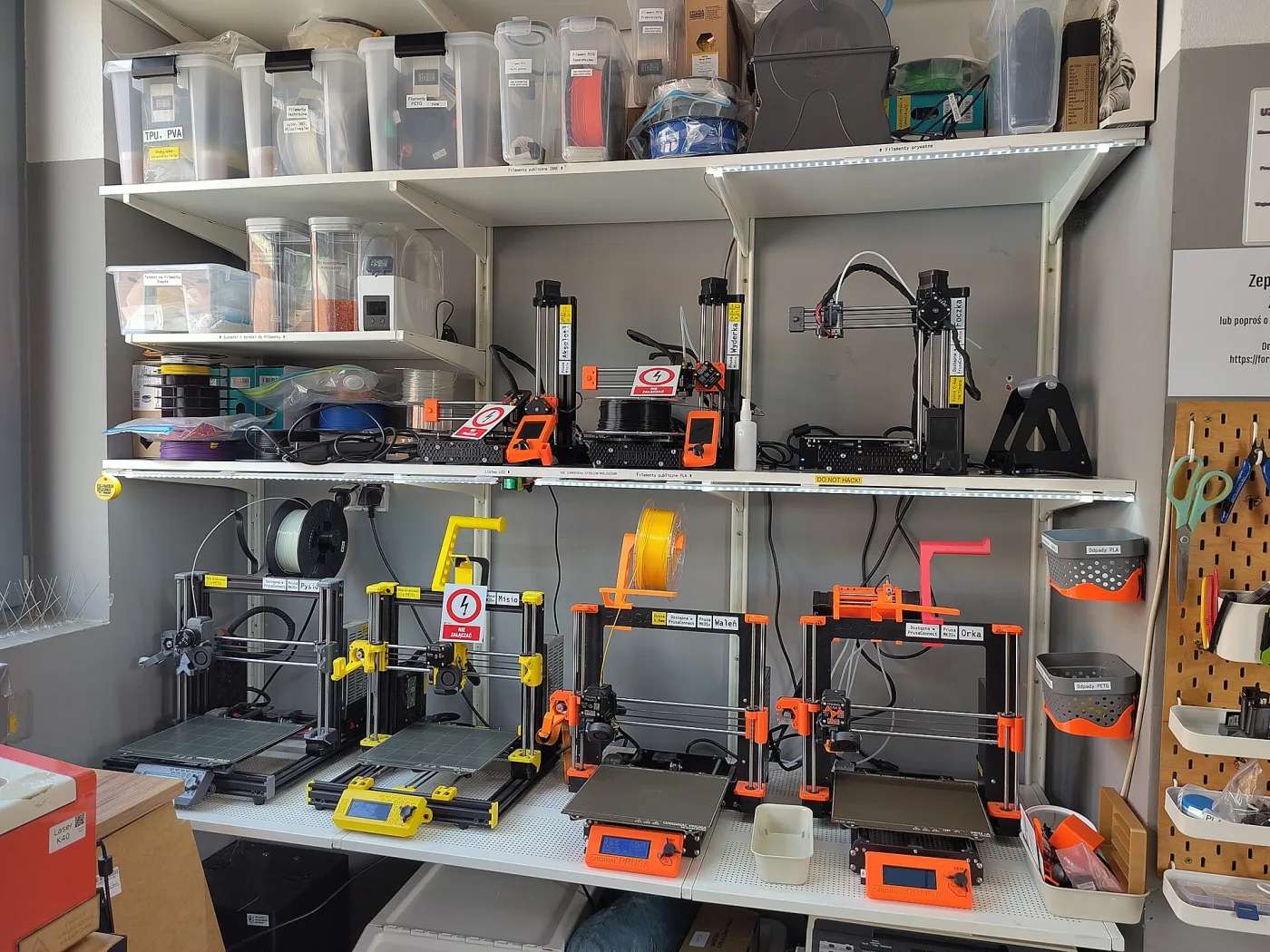
FFF workshop air cannot be characterised by one inexpensive PM2.5 sensor. Printing can emit ultrafine particles, larger polymer fragments and volatile organic compounds; their size, chemistry, settling and health interpretation differ. A sound plan defines the decision first: identify a source, estimate worker exposure, compare controls or perform routine surveillance.
1. Define the decision
Testing whether an enclosure reduces emissions is different from measuring an operator's shift exposure. Record machine, filament, colour, nozzle and bed temperature, job, duration, room volume, air exchange, extraction, door opening and occupancy. A number from an undefined workflow is not reproducible.
2. Separate the fractions
Particles below 100 nm are best followed by number concentration; their mass may be small, leaving a PM mass sensor nearly silent. Optical PM1/PM2.5/PM10 can show trends, but polymer optics and particle shape affect conversion. Microplastic identification may require microscopy plus FTIR, Raman or Py-GC/MS. Total-VOC indicators and targeted sorbent/GC-MS sampling provide different levels of evidence.
The recent University of Florida study used passive one-week fallout collection. It revealed spatial deposition but not personal dose and did not fully characterise the smaller long-suspended fraction. Match the method to the decision.
3. Build background and controls
Measure without printing at the same time of day, then before, during and after the job. Include room background, a near-source location and, when appropriate, the breathing zone. Outdoor air, cleaning, textiles, soldering, sprays and other machines are confounders. Field blanks expose contamination from holders, transport and laboratory handling.
Synchronise sensors with warm-up, purge, first layer, steady printing, enclosure opening, part removal and cooldown. A shift average can hide a brief peak, while a noisy instantaneous spike cannot establish sustained exposure.
4. Verify instruments
Record maker, model, serial number, calibration, flow, range, time resolution and processing. Co-locating two nominally identical low-cost sensors reveals agreement and drift. Co-location against a reference is stronger than accepting nominal display accuracy.
Tube length, condensation, electrostatic loss and pump flow distort small-particle measurements. Document the inlet and line. For laboratory polymer identification, test recovery with standards of known size and composition.
4a. Design a repeatable measurement campaign
Replace a single print with a representative matrix of feedstock, temperature, duration, printer count and enclosure state. Randomise or at least alternate the order so time of day, outdoor air and filter loading do not always bias the same configuration. Give every condition equally long background, active and decay periods, with at least three repeated runs.
Report the raw time series together with median, range, between-run variation and change relative to background. Do not convert values below detection into zero. Handle missing data, sensor saturation, door opening and abnormal purge events under predefined rules. This creates an auditable comparison instead of selecting the most favourable run.
5. Compare controls under matched conditions
When evaluating enclosures, extraction or filters, keep G-code, material lot and environment constant and repeat runs. Measure enclosure leakage, airflow and pressure difference; filter class alone does not prove whole-system capture efficiency.
Source capture exhausted outdoors is generally stronger than recirculating room air, but discharge and make-up air require design. Carbon saturates, particle filters load and seals leak. Replacement should follow measured condition and supplier limits.
6. Distinguish hazard from risk
Detection does not automatically establish disease, but uncertainty is not a reason to omit controls. Exposure depends on concentration, duration, size, chemistry and susceptibility. NIOSH's hierarchy prioritises substitution and engineering controls before administrative measures and suitable PPE.
A safety data sheet is necessary but does not describe the complete thermal-emission mixture. PLA is not zero-emission, and ABS and engineering polymers can produce different VOC and particle profiles at higher temperatures. Treat exact brand, colour and additive package as variables.
7. Set acceptance rules
Predefine peak, time-weighted average, integrated particle number, target compound, deposition rate or reduction relative to control. State uncertainty and action on failure. Where no health limit exists for a microplastic fraction, use process control and reasonably achievable exposure reduction rather than inventing a false safety threshold.
A routine monitor alarm should trigger action: pause, inspect enclosure and extraction, ventilate and record the event. A laboratory campaign can validate the control; a low-cost sensor can then guard trends, not identify chemistry.
8. Control changes
New filament, higher temperature, more printers, another enclosure, filter replacement, relocation or ventilation changes can require reassessment. Preserve raw data, timestamps, calibration, layout photographs, G-code, material lot, environment and deviations.
Common errors
Do not infer ultrafine particles from PM2.5 alone, generalise one short run, measure without background, ignore enclosure-opening peaks or treat filter purchase as proof. Do not report fallout as airborne concentration or room concentration as personal dose.
Editorial conclusion
A credible FFF air programme combines source knowledge, suitable instruments, background, repeats, engineering controls, maintenance and change control. The goal is not a reassuring number, but evidence that emissions are reduced at source, controlled around workers and remain controlled after change.
Sources
The method is grounded in NIOSH Publication 2024-103, EPA indoor-air and particle-measurement resources, and Thompson and Jung's 2026 peer-reviewed makerspace microplastics study.