Qatar's 3D-printed schools move to roofs and interior work
Printed walls are complete for two 20,000 m² schools, but the programme is behind its original end-2025 target.
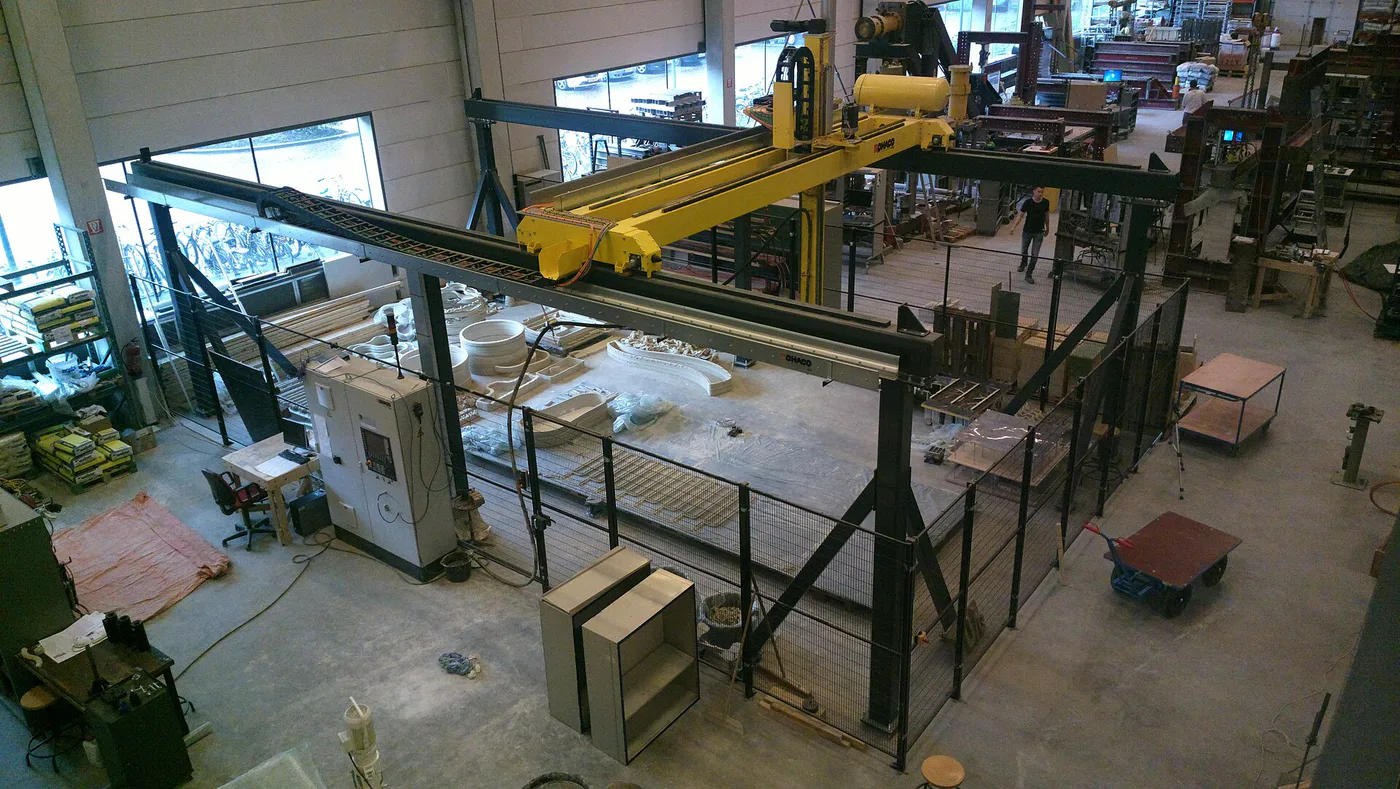
Concrete-wall printing is complete on two roughly 20,000 m² schools in Qatar, and construction has moved to roofs, windows, doors and interior work. That is a major technical milestone, but it is not occupancy. The original end-2025 completion target has passed, so the public timeline clearly indicates delay.
The actual programme scope
The wider programme covers 14 public schools; two use 3D-printed walls. Each is a two-storey building on a 100 × 100 m plot with about 20,000 m² of built area. The combined 40,000 m² therefore cannot be confused with printed wall surface or with the area covered from one printer position.
BODXL: a large machine that still had to move
UCC ordered two COBOD-supplied BODXL systems, each about 50 m long, 30 m wide and 15 m high. Even that envelope did not cover an entire building. The trade report says the system was dismantled, relocated and rebuilt 15 times, underscoring the burden of site logistics, reference recovery and quality control.
What 500 kilometres of layer paths means
Published figures include 30,000 m² of printed wall surface, more than 500 km of accumulated layer paths and about 2,000 m³ of concrete. These measure different things: path length sums deposited lines, wall area describes surfaces, and built area describes building scale. None proves productivity or carbon savings by itself.
Night printing and preparation
Much work took place at night to avoid Qatar's peak heat. Before the 2025 start, the contractor reported eight months of preparation, more than 100 full-scale trials, local mix development and a custom nozzle. These are company figures, but they show that large concrete printing begins with material, environment, path and operator validation rather than machine delivery.
What remains after printing
Walls are one building subsystem. Roofs, slabs, openings, façades, waterproofing, mechanical and electrical services, fire protection, networks, finishes, furniture, utilities and regulatory acceptance remain conventional or hybrid work. Any time or cost advantage has to be measured across the whole project, not printing hours alone.
Evidence behind sustainability claims
UCC and COBOD expect less waste, concrete, transport and emissions. No project-specific public life-cycle assessment, conventional reference school, energy log or repair record is available. The flowing dune-like geometry demonstrates digital path freedom, but geometric freedom is not measured environmental saving.
Record and success: evidence still needed
A 'world's largest' claim needs a consistent definition: built area, printed volume, wall surface and contiguous building are different records. A final assessment needs handover date, total labour, material and energy, scrap and site repair, cost, structural and durability checks, and operating performance. The current update does not provide them.
Editorial conclusion
The Qatar programme already shows that an extremely large gantry can print major wall systems through repeated relocations in a hot climate. It also exposes the boundary of the technology: an automated wall does not automatically shorten the whole school project. The next decisive milestone is a handed-over, approved and measurably operating building.
Sources
The primary source is UCC's 11 June 2025 project-start release. A 30 October 2026 3Dnatives report records the end of wall printing, current roof and fit-out work, and delay against the original schedule.