ScaffoldForge generates bone-scaffold designs in 12 seconds
The open conditional diffusion model creates 64³-voxel geometry from eight targets; physical validation remains absent.
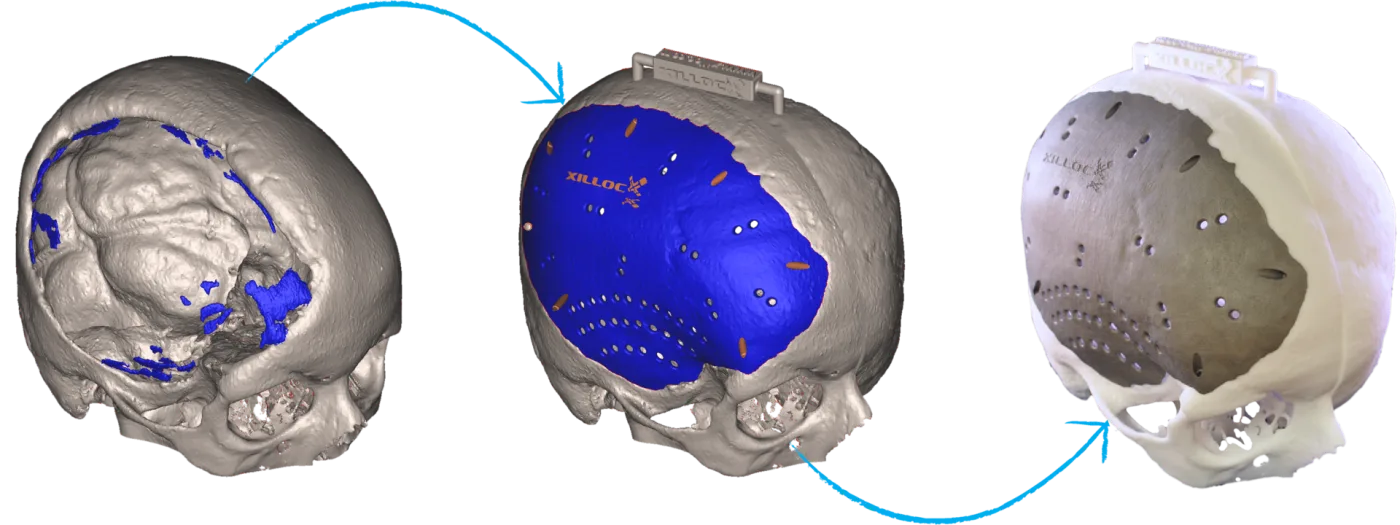
ScaffoldForge is a conditional diffusion model that generates 64³-voxel bone-scaffold geometry from eight structural and transport descriptors. The PLOS One paper published on 28 October 2026 reports a 12-second design time on an NVIDIA A100, compared with 8,400 seconds for the authors' topology-optimisation baseline.
What conditions the model?
The target vector includes bone-volume fraction, trabecular thickness, spacing and number, connectivity density, structural model index, degree of anisotropy and permeability. Adaptive instance normalisation injects these conditions into volumetric generation, while an empirical physics-constrained loss addresses stiffness, manufacturability and perfusion.
Dataset and reported results
The initial set contained 250 scaffolds: 200 generated in software and 50 real examples with experimental mechanical data. Augmentation increased this to 2,050 samples. The computational evaluation estimated 56.6 MPa compressive strength, 8.2% above the topology-optimised baseline; a five-seed comparison returned p=0.043.
Anatomical fit and generalisation
The authors ran a CT-to-segmentation-to-scaffold pipeline across 20 public spine cases and reported fit within their chosen 1 mm tolerance. Descriptor error increased by 65% on unseen anatomical distribution. Expanding the corpus reduced error from 0.079 to 0.058, an improvement that does not eliminate domain shift.
The decisive evidence limit
The evaluation is entirely in silico. Generated scaffolds were not printed or tested mechanically or biologically, and there are no sterilisation, cell, animal, fatigue or manufacturing-repeatability results. The roughly 0.5 mm grid feature scale is an order of magnitude coarser than natural trabeculae at about 50 micrometres.
Editorial conclusion
The reported 700-fold speed-up may be useful for design screening, but it is not clinical performance evidence. The next gate is file manufacturability, followed by printing identical geometries, CT deviation measurement, compression and fatigue tests, flow testing and biological evaluation.
Sources and open reproducibility
The primary source is the CC BY PLOS One paper. The authors also publish code, data and pretrained models in the ScaffoldForge GitHub repository, enabling computational checking without replacing physical validation.