SINTX prepares SiN/PEEK implant platform with EXT 220 MED printers
The SiNERGY programme is preparing a 510(k) route for patient-matched extremity implants; its 2027 schedule is a conditional company target.
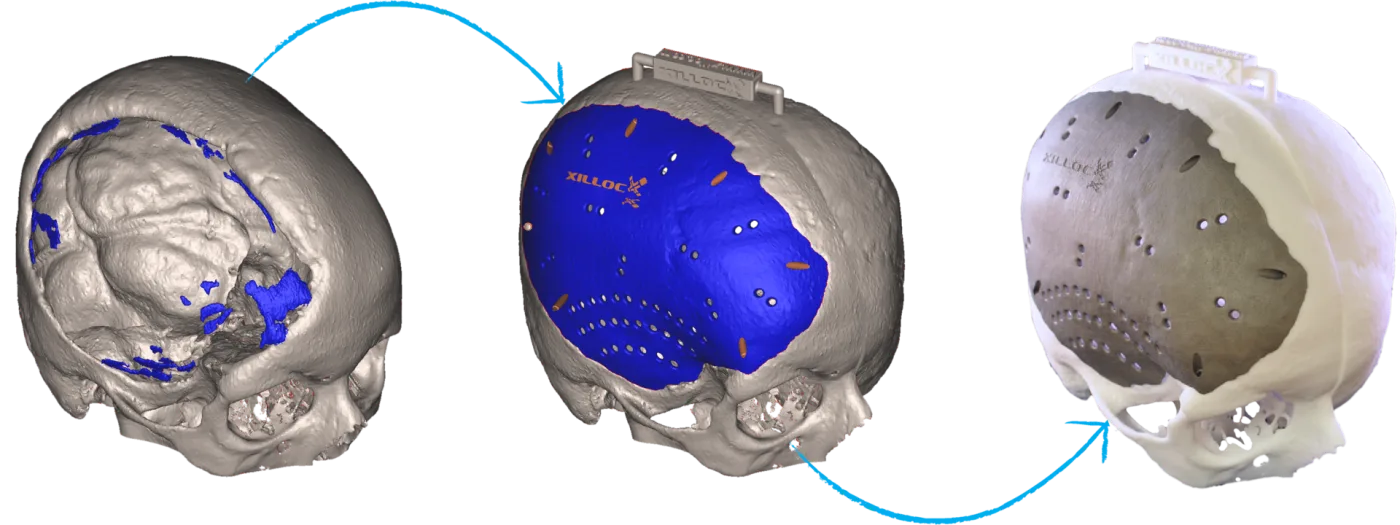
SINTX Technologies has completed a production-space buildout and received 3D Systems EXT 220 MED medical extrusion printers for its SiNERGY silicon-nitride/PEEK implant platform. The company expects specialised filament from Evonik before the end of 2026 and intends to prepare a 510(k) submission for patient-matched extremity implants.
What is complete and what remains a plan
The facility, printer delivery and stated regulatory programme are verified company facts. SINTX says it may produce a limited number of qualifying custom devices in the first quarter of 2027, explicitly subject to conditions. Cranio-maxillofacial and spinal applications are later 2027 goals. None of those dates is FDA clearance or permission for general commercial sale.
EXT 220 MED is a closed, integrated cleanroom-concept system with a chamber rated to 250°C and open filament handling. That is relevant to high-temperature PEEK, but the specific SiN-filled feedstock still needs its own extrusion, cooling, crystallinity and dimensional process window.
What the laboratory evidence shows
A related peer-reviewed study evaluated PEEK containing 15 vol% silicon nitride in solid and porous interbody-cage geometries. In ASTM F2077 static tests, specimens exceeded 14.7 kN in compression and 6.9 kN in compression-shear. Its in-vitro work reported 93.9% lower bacterial adhesion and enhanced cell proliferation against the tested comparator.
Those are meaningful development signals, but 93.9% is not a clinical infection reduction. Surface condition, bacterial strain, incubation and control define the claim. It does not establish post-sterilisation performance, long-term biocompatibility, fatigue or patient outcome.
Patient-matched is not a custom-device exemption
FDA distinguishes patient-matched devices produced within a predefined design envelope from the narrow custom-device exemption. A design-envelope 510(k) strategy requires bounded size and geometry, manufacturing rules and worst-case evidence. Personalising a digital file does not waive design controls, risk management or process validation.
The remaining evidence gates
The programme must connect powder and PEEK identity, filament mixing uniformity, moisture, extrusion thermal history, crystallinity, interlayer bonding and accessible SiN at the surface. Dimensional and mechanical qualification, ISO 10993 biological evaluation, sterilisation, packaging, shelf life and clinical justification follow.
The company's latest Form 10-Q also describes operating losses and financing risk. That does not invalidate technical results, but it matters to the schedule: regulatory execution carries resource risk as well as engineering risk.
Verified fact, vendor claim and editorial conclusion
Equipment, facility and published laboratory results are traceable to primary sources. The 2027 clinical and market dates are company targets. Our conclusion is that the platform's novelty is not simply printable PEEK, but a structural polymer and potentially bioactive ceramic joined in a controlled patient-matched chain. Lot-to-lot SiN distribution, post-sterilisation properties, fatigue and FDA review will determine its value.
Sources
The lead source is SINTX's 11 November 2026 investor release. The 3D Systems EXT 220 MED page and a PubMed-indexed paper provide technical context; FDA additive-manufacturing, patient-matched and custom-device guidance defines the regulatory boundaries.