SPEE3D opens the first phase of its planned 50-factory network in Darwin
NodeZERO is intended as CriticalSPEE3D's training and qualification hub; Phase One is open, while 50 operating factories remain a plan.
SPEE3D launched Phase One of NodeZERO in Darwin on 9 November. The Australian company presents the site as the first node in CriticalSPEE3D, a plan for 50 small, rapidly deployable factories across Asia-Pacific. The network would make critical metal parts near mines, ports, gas facilities and defence bases, while Darwin would serve as a training, induction and qualification hub. The verified event is narrower than the full vision: Phase One opened and hosted a live cold-spray demonstration. A functioning 50-factory network remains a corporate plan.
What opened in Darwin?
The company says NodeZERO Phase One is open to founding members with recurring problem parts in Northern Australia and beyond. Guests from industry, defence and government watched a metal component being produced at the launch. The public material does not disclose a complete machine list, rated annual capacity, approved-part catalogue, service prices or customer qualification results. NodeZERO can therefore be described as an operating first-stage service and training node, not yet as a fully utilised production network.
SPEE3D proposes accessible sites roughly the size of a basketball court, operated as a service close to demand. The stated target is not every machined component. It is large, robust and urgent metal parts whose absence can stop remote assets. The company cites flanges, pump components and corrosion-prone items as suitable examples.
Cold spray does not melt the powder
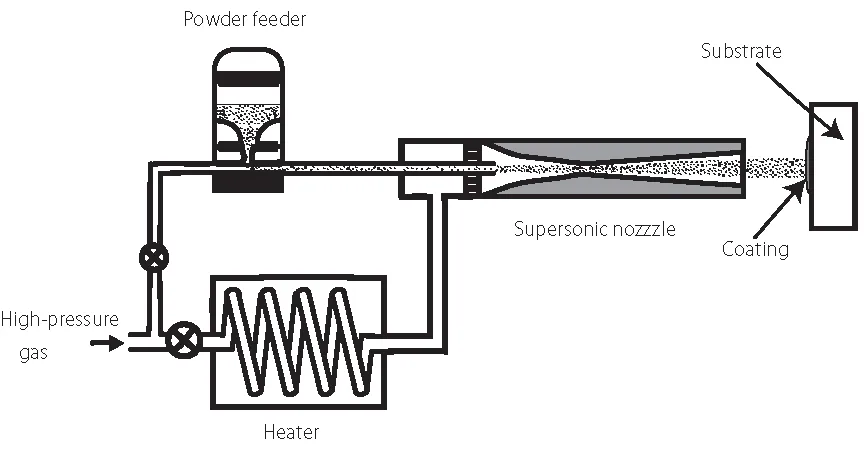
Cold Spray Manufacturing accelerates metal particles in a gas stream so that severe plastic deformation bonds them to a substrate and to each other. SPEE3D quotes velocities up to three times the speed of sound. Without a laser melt pool, thermal history, oxidation and residual stress differ from LPBF or fusion-based DED. That does not make the deposit an automatic finished part: SPEE3D's own network page includes heat treatment and machining in the local workflow.
High deposition rate and comparatively low heat input can be useful, but powder, gas, nozzle, path, interlayer condition and post-processing jointly determine density, bonding and properties. Reproducing geometry does not establish functional equivalence. A critical application still needs material testing, NDT, dimensional inspection, traceability and approval against the actual load case.
A network is harder to validate than one machine
With 50 sites, the central problem is not merely installation. The same digital build package, powder state, calibration, heat treatment, machining and inspection decision must be reproduced across environments and teams. If two factories make different material from the same drawing, geographic proximity only moves supply risk into quality assurance.
NodeZERO would therefore need reference builds, inter-machine equivalence, powder and process traceability, common release rules and revocable digital authorisation in addition to training. The public announcement promises a training and qualification hub but does not yet publish the methodology or boundaries of that qualification.
Workforce and regional capability
The plan covers operators, CNC machinists, quality staff and application engineers in Northern Australia. Charles Darwin University and TAFE NT are named as training pathways, alongside an Indigenous recruitment and training commitment. These are programme commitments, not published outcomes: headcount, curricula, certification and training throughput are not disclosed. CDU's supportive statement establishes institutional interest, not an independent production audit.
What do 66 or 70 earlier deployments prove?
The network page cites 66 deployments while the 9 November release cites 70. The most likely explanation is a different update date, so neither figure should be treated as an audited active installed base. SPEE3D also cites combat, maritime, desert and arctic use and six defence forces. These are vendor evidence of field deployment, not automatic proof of capability at every future network site or approval for every part.
Editorial conclusion
NodeZERO matters because SPEE3D is moving from deployable machines towards a persistent regional manufacturing service. Opening Phase One is a verified event; 50 factories, shorter waits and network economics remain forward-looking claims. The decisive next milestone will not be another map pin. It will be a documented part journey from demand and engineering approval through manufacture and finishing to a released component performing in service.
Sources and transparency
The primary sources are SPEE3D's 9 November release and CriticalSPEE3D page. Both are interested corporate sources. They do not provide an independent capacity audit, customer performance result or funded timetable for all 50 sites, and this article does not present those outcomes as established facts.