Voron releases open Chariot X carriage and DownDraft toolhead
GPL-3.0 designs support MGN12 rails, Clockwork 2 mounts, multiple probes and dual-4010 or dual-5015 part cooling.
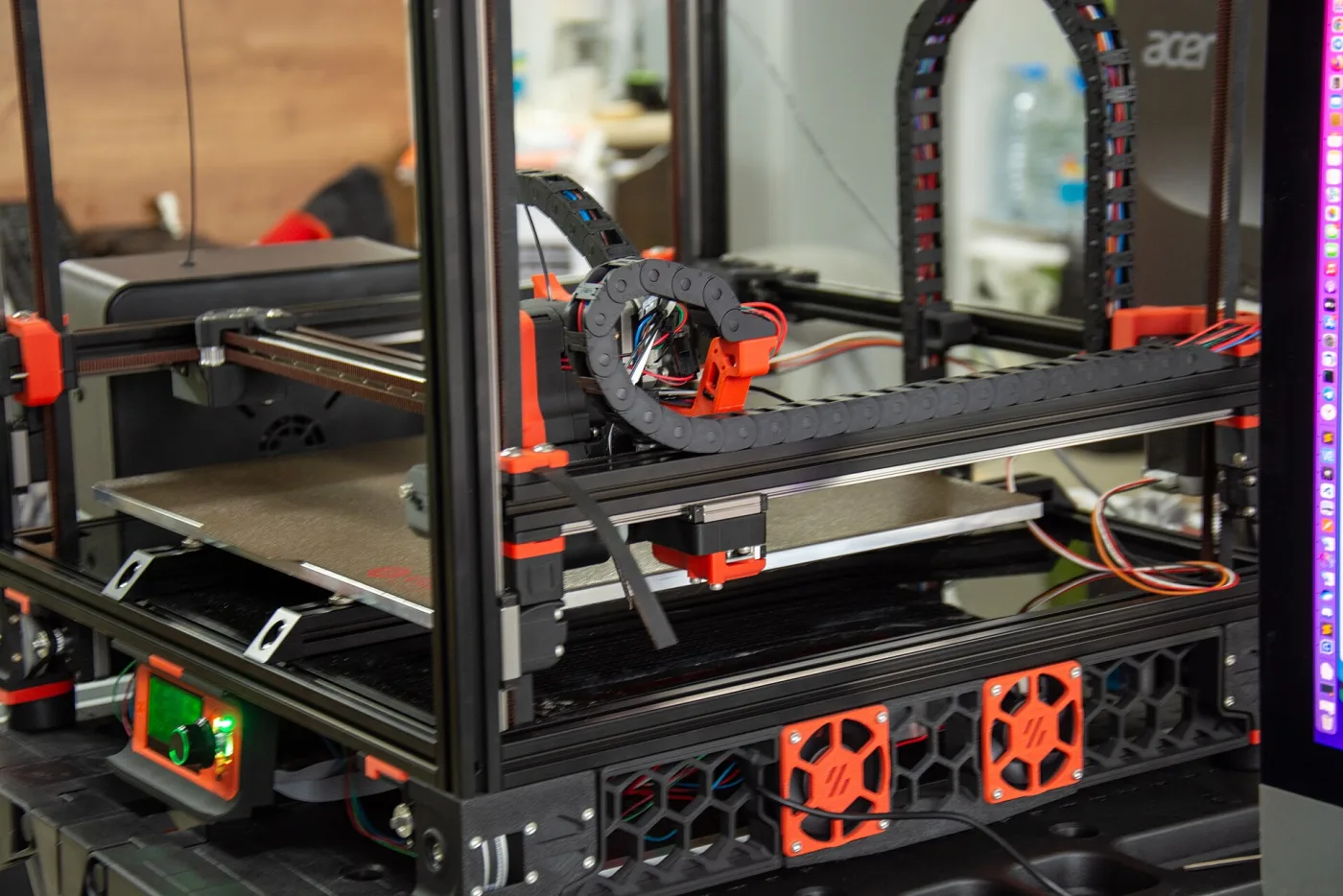
Voron Design has publicly released the Chariot X carriage and DownDraft toolhead. Design files, bills of materials and documentation are available through the official GitHub organisation under GPL-3.0. The release, also covered by trade media on 8 November, is not a new printer. It is a modular carriage and toolhead platform inside the Voron ecosystem. The repositories, documented compatibility and released mechanics are verified; comparative advantages in thermal performance, noise, mass or print quality still require independent testing under a common protocol.
What do the two projects separate?
Chariot is an X carriage for an MGN12 linear rail. Voron's documentation says it can slide onto the rail from either side and places the toolhead 1.6 millimetres closer to the rail. It uses the Clockwork 2 mounting pattern, providing a mechanical base for selected Stealthburner, DownDraft, XOL and A4T variants. Belt clips remain adjustable after assembly, which can help align belt paths and parallelism.
DownDraft is the separate toolhead. Voron names Trident, V2, Legacy and Switchwire as target platforms. Two principal part-cooling configurations are documented: dual 4010 fans for a slimmer, lighter arrangement and dual 5015 fans for greater airflow. A 2510 fan cools the hotend. The design supports 36-millimetre toolhead PCBs and, where geometry permits, Stealthburner-style boards, LEDs, strain relief and either umbilical or cable-chain routing.
Probes and compatibility
Chariot documentation lists Beacon and Cartographer non-contact probes, BTT Eddy or Omron options, Klicky and PINDA. That does not mean every combination preserves the same build envelope, nozzle offset and firmware settings. A real configuration needs CAD collision checks, endstop review, cable bend-radius checks, voltage matching for fans and hotend, and an appropriate Klipper configuration.
What should be measured after conversion?
A new carriage or toolhead can change moving mass, centre of gravity, resonance and airflow. Commissioning should begin with collision checks, belt-path inspection and fastener checks through thermal cycles. Homing, Z offset, input shaping and pressure advance then need recalibration. Dual-4010 and dual-5015 versions should not be compared only at maximum fan percentage: use the same material, layer height, bridge and overhang artefacts, noise measurement and hotend-temperature logging.
Open source is not packaged product support
GPL-3.0 permits study, modification and redistribution under its terms. The manufactured result still depends on printed-part material and orientation, purchased fans, fasteners and board quality, and assembly. Community documentation is not a product warranty or a declaration of conformity covering every third-party combination.
Editorial conclusion
The release matters because it offers standardised interfaces and documented choices. Chariot may reduce mechanical redesign between carriage configurations, while DownDraft provides two cooling directions around a common architecture. Selection should start from a local requirement list—kinematics, hotend, probe, PCB, wiring, mass, noise and actual materials—not simply the largest fan or newest CAD revision.
Sources and evidence boundary
The primary sources for release status, licence and mechanical compatibility are Voron Design's official repositories, documentation and forum release post. They are developer sources. This article does not treat unpublished durability, noise or quality advantages as independently established.