Bambu Lab launches H3C with nine swappable tools
Swaptek targets six-second material changes, separate filament paths and mixed nozzles in a 330 × 320 × 325 mm machine from €2,499.
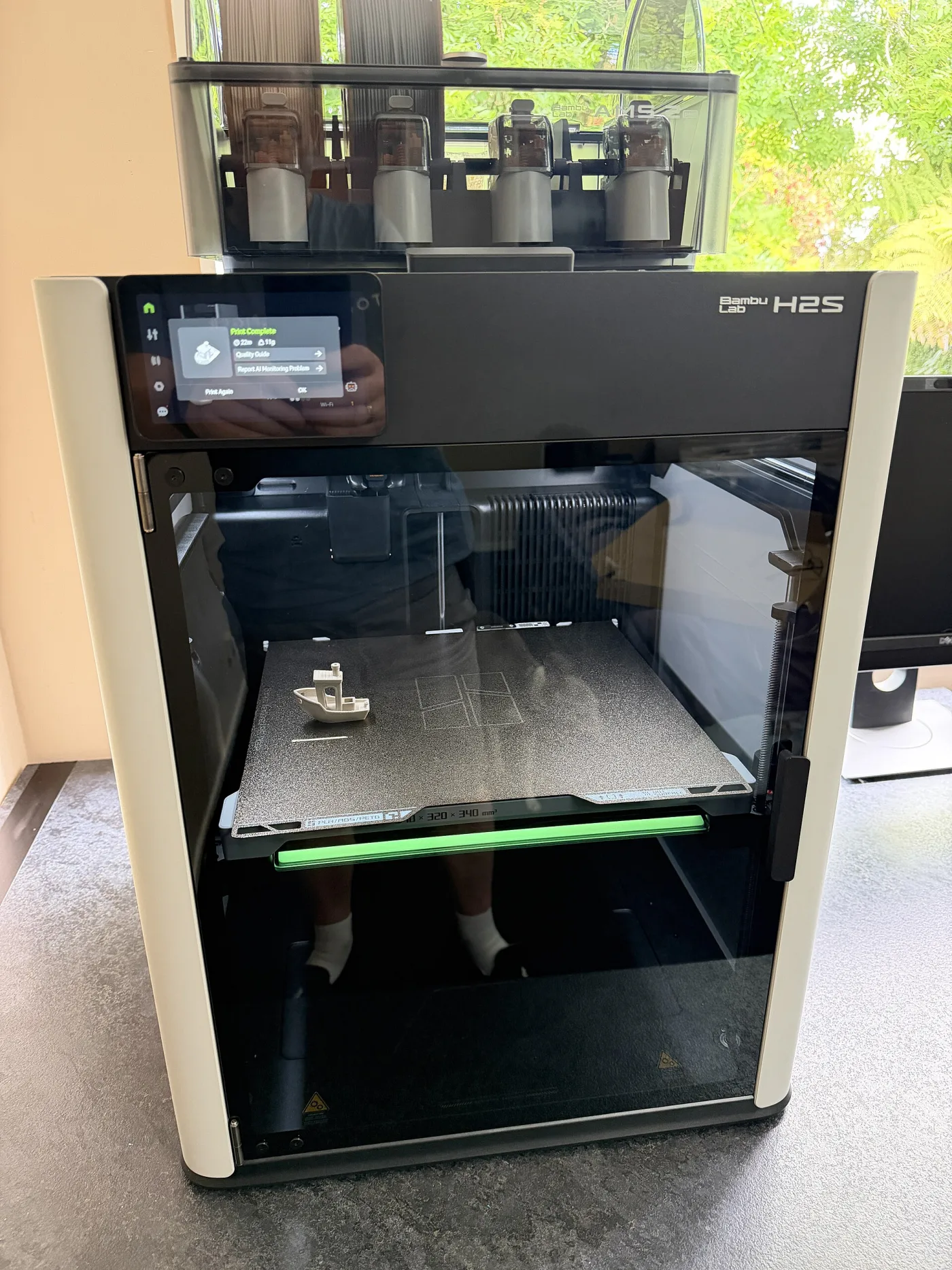
The teaser is now a verifiable product
Bambu Lab fully unveiled the H3C on 3 November, closing the main questions left by the October preview. It is the company's first third-generation printer and is built around the Swaptek automatic tool changer. Nine positions are available, with a dedicated filament path and heater for every tool. That separates it from multi-material systems that feed a shared melt zone and often need long purges between materials.
The verified specification gives a 3.4-second physical tool change and a six-second complete material-change cycle. A parked tool can be preheated so the next material does not start cold. These are vendor cycle-time figures: they describe the mechanism's design target, not an independent measurement of time, scrap and maintenance across long nine-tool jobs.
Build volume, temperatures and material path
The H3C provides a 330 × 320 × 325 mm build volume, a 350 °C nozzle limit, a 120 °C bed and a 65 °C active chamber. The enclosure uses H11 HEPA filtration. Bambu lists 0.2, 0.4, 0.6 and 0.8 mm nozzles and allows different diameters across tools. Bambu Studio coordinates paths for mixed nozzles, but users still need to verify wall thickness, overlap and the effect of different extrusion widths.
Support for both 1.75 and 2.85 mm filament is unusual. It may broaden sourcing for industrial and flexible materials, but it does not qualify every 2.85 mm product automatically. Temperature window, moisture, retraction, flow resistance and bed adhesion still require a material-specific profile.
AMS 3H and soft TPU
The new AMS 3H is a two-spool dryer and feeder that reaches 85 °C. It offers seven bypass ports for direct material paths, while the wider ecosystem can theoretically expand to 24 spools with existing AMS units. Stored spool count and nine simultaneously available tools are different capacities; the production plan must map each material to a tool, drying state and profile revision.
Bambu says the FlexFeed tool can handle TPU as soft as 75A and deliver up to three times the volumetric flow for some flexible materials. That remains a vendor claim unless tied to a named material, geometry, layer height and acceptance criterion. Flexible-to-rigid parts also require interface, shrinkage and cyclic-load testing.
Motion figures and optional tools
The company specifies 25,000 mm/s² acceleration and 1,400 mm/s travel, and says the toolhead and X axis are 40% lighter than the H2D assembly. These are upper motion-system figures. Real part time is governed by tool sequence, thermal stabilisation, bed and chamber conditions and the selected quality limits.
Swaptek can carry more than extruders. The optional CutTool is for cutting, DrawTool for drawing and DebossTool for surface marking. These functions move the H3C towards a small manufacturing cell, but common coordinates, change repeatability and tool wear need the same validation as nozzle offsets.
Price and availability
European launch pricing starts at €2,499 including tax, while the US list price is $2,499 before tax. A fair comparison must therefore normalise tax, included tools, AMS configuration and optional equipment. Nine tools do not alone prove a lower total cost: the result depends on purge waste, cycle time, maintenance, downtime and reject rate together.
Editorial conclusion
The significant engineering change is not simply the number nine, but the combination of separate filament paths, active preheating and fast mechanical exchange. H3C may be useful where many colours, support material, flexible and rigid regions or mixed nozzle sizes are required. Production capability still has to be demonstrated on the user's job through pairwise offsets, a complete nine-tool cycle, long-run reliability, interface tests, waste mass and controlled profile rollback.