Microplastic fallout measured in a university makerspace using FFF printers
Black fragments measured 21–898 µg/m²/day across the study sites, but passive fallout sampling is not a personal inhalation dose.
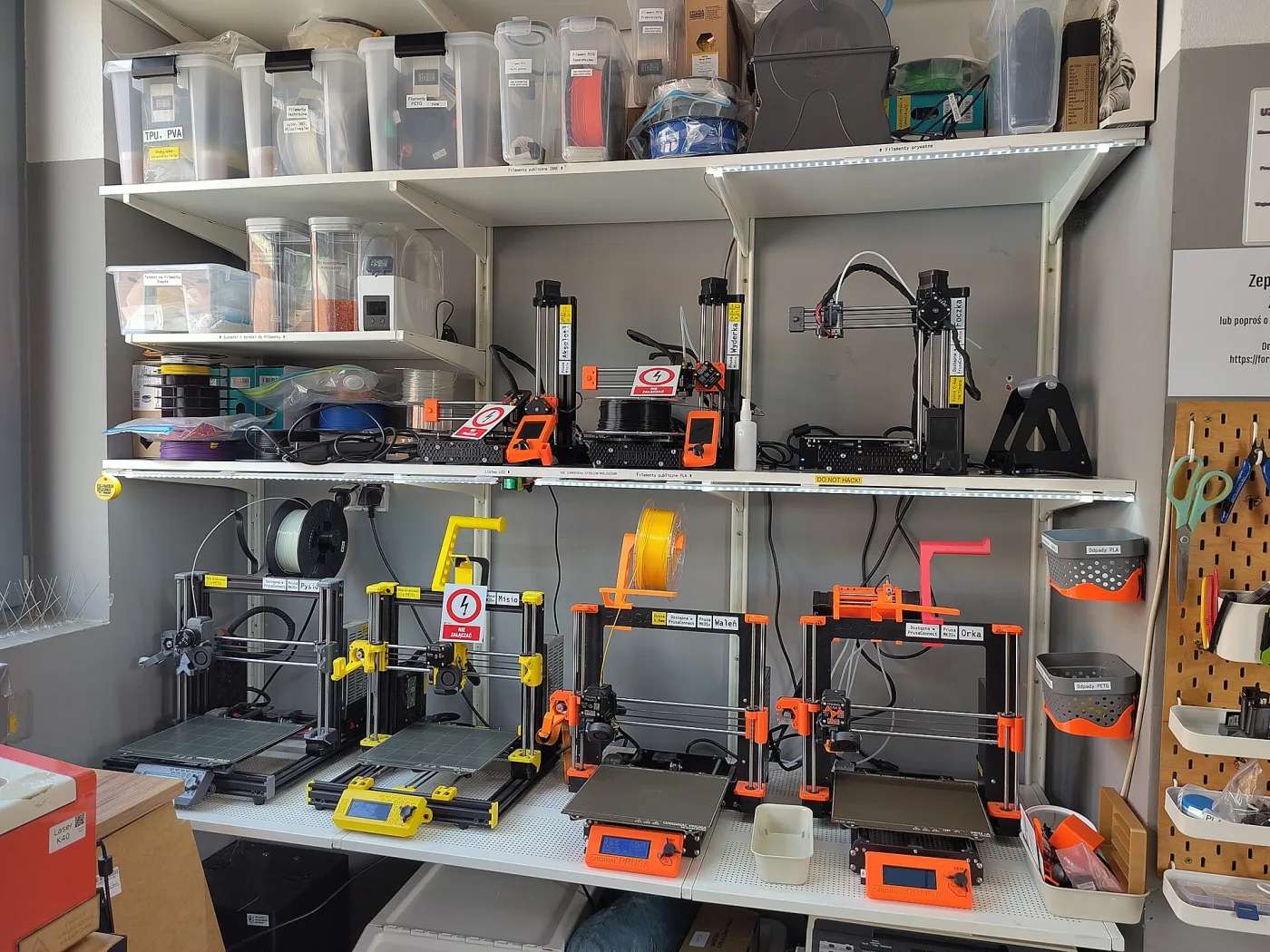
University of Florida researchers collected settled particles for one week at six points in a makerspace containing ten functioning filament-extrusion printers and textile activities. Stereomicroscopy counted particles above 10 µm, while pyrolysis gas chromatography/mass spectrometry estimated mass deposition for polymers above 1 µm. Black MMA-associated fragments appeared at every location, including inside a printer enclosure and just outside the room.
How the study was conducted
The March 2024 campaign exposed pre-cleaned 600 ml beakers for one week. Five sites were inside, one immediately outside, and a blank was included. Twelve FFF machines were present, ten functioning; the space was generally open from 2 to 7 pm with six to eight and at most twelve users. This was passive fallout sampling, not real-time airborne concentration or personal inhalation dose monitoring.
Recovery tests varied by size and polymer: 90% for 900 µm polystyrene, 77.5% for 600 µm PMMA and an average 73.5% for 5 µm polystyrene. That uncertainty matters most for smaller particles.
What the researchers found
Estimated black-particle deposition was 898.26 µg/m²/day inside the enclosure, 507.72 outside an unfiltered enclosure, 60.52 beside a filtered enclosure, 50.20 at a workbench, 51.65 immediately outside the room and 21.27 at the farthest counter. Py-GC/MS identified MMA as the principal pyrolysis product of the black fragments, and the authors treated PMMA as the predominant associated polymer.
Many coloured fibres were also present. A strong caprolactam signal associated with PA6 appeared at the textile workbench, while PE, PP, PVC and PA6 markers were detected. The makerspace was therefore a multi-source environment; colour or shape alone cannot prove a printing origin.
What the filter result means
Deposition beside the filtered enclosure was much lower than at the unfiltered location. The authors nevertheless reported poor capture below roughly 15 µm. This was one enclosure under local conditions, so it does not establish a universal HEPA efficiency, a reduction applicable to every printer, or a safe exposure level.
The central limitations
Fallout is not the same as suspended aerosol. Density, shape and size determine residence time, so passive collection can underrepresent the inhalable fraction below 10 µm and especially the respirable fraction below 2.5 µm. There was one exterior site, one institution and one week; printers, filaments, workload and ventilation differ elsewhere.
The paper is an early peer-reviewed, DOI-bearing version still subject to editorial changes. It measured no health outcome and established no causal disease relationship. Printing origin for the black fragments is inferred from location, morphology and chemical signal, and the authors use appropriately cautious language in a mixed-source space.
Practical consequence for makerspaces
The answer is not simply to buy one purifier. Map printers, materials, tasks, workload, airflow and exhaust discharge first. Source-capture exhausted outdoors, enclosures, correctly fitted particle and gas filtration, maintenance records, cleaning and separation of textile and printing activities work as a system. Active air sampling, ultrafine-particle counts, VOC measurement and background controls should verify performance.
Verified fact, research interpretation and conclusion
It is verified that polymer deposition was found at all sampled points and that reported rates differed greatly by location. Printing contribution and transport outside are research interpretations. Our conclusion is that the paper justifies measuring ventilation and source control, but cannot determine personal dose, a health-risk threshold or universal filter efficiency.
Sources
The primary source is Thompson and Jung's open peer-reviewed article in Aerosol and Air Quality Research, supplemented by NIOSH guidance for additive-manufacturing controls.