Orbital Matter prints a boom in open space to deploy a solar array
Replicator 2 printed a 32.5 cm hollow photopolymer boom in 30 minutes and used its growth as a deployment mechanism.
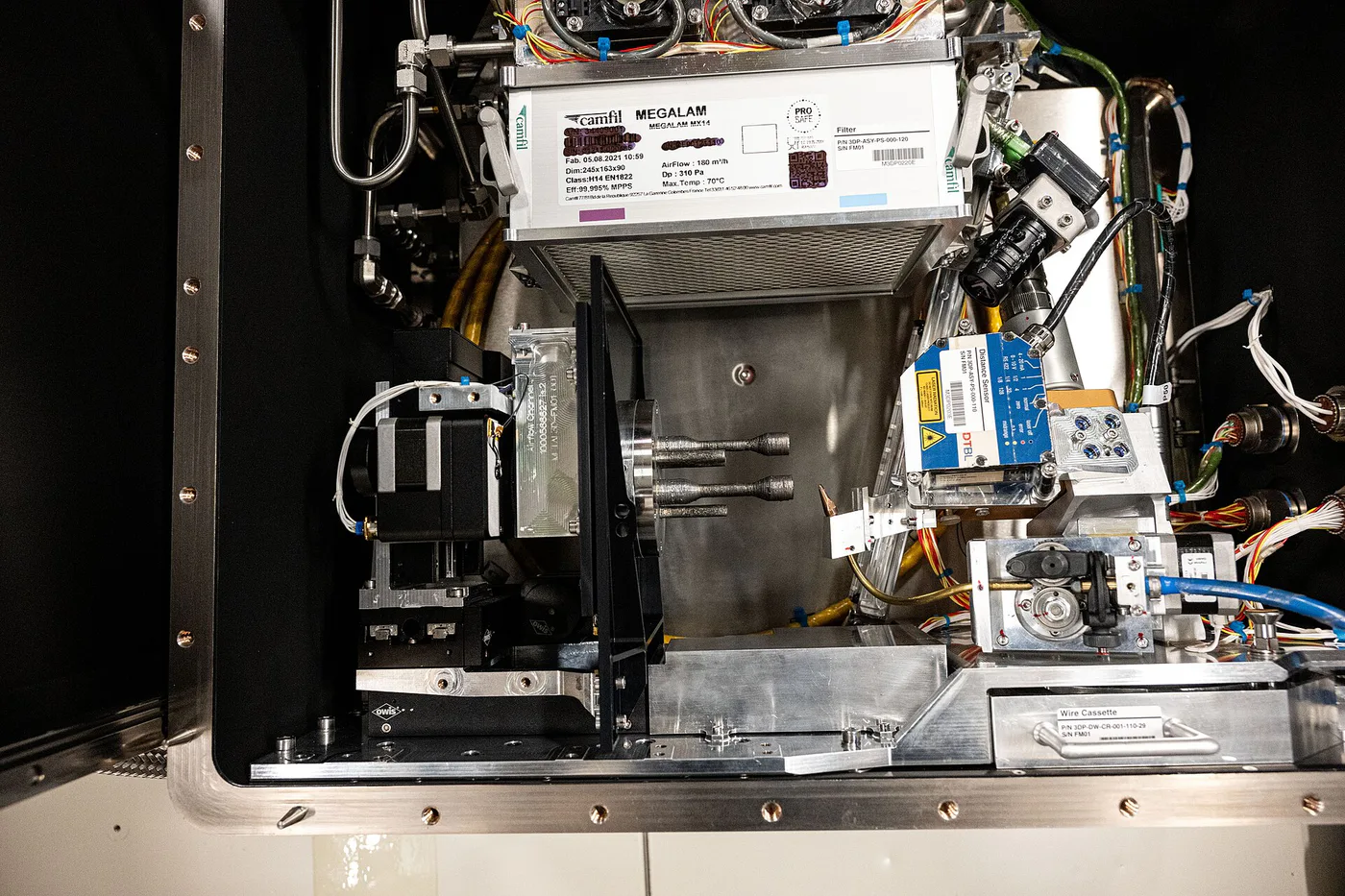
One of four printers aboard Orbital Matter's Replicator 2 satellite produced a hollow photopolymer boom 32.5 cm long and 3.8 cm in diameter directly in open space in 30 minutes. The continuously printed spiral was not merely a coupon: it pushed out a stowed solar array positioned above the printer, turning growth of the structure into a deployment mechanism.
What happened and why it is new
ESA's 11 November report describes it as the first known part manufactured in the uncontrolled environment of open space. Earlier additive experiments operated inside pressure- and temperature-controlled volumes such as the ISS. This process worked outside, exposed to vacuum, microgravity and thermal variation between sunlight and shadow.
The printer is only slightly larger than a Rubik's cube. It deposits liquid photopolymer on a rotating platform and uses light to solidify a continuous spiral. Avoiding the high thermal input of metal melting or thermoplastic extrusion may be valuable where spacecraft electrical power is limited.
What the mission demonstrated
The reported build time, geometry and successful solar-array deployment are established facts. ESA says the resin had spent three months in orbit before printing and that the process operated in daylight and darkness. The company described a visually consistent structure with little apparent outgassing. Those observations matter, but they are not substitutes for mass, dimension, stiffness and lifetime measurements.
The demonstration combined two functions: manufacturing a rigid member and using its growth to perform deployment. That may reduce the need for a separate motor, hinge and release mechanism. Reliability, however, requires repeated missions, failure-mode evidence and long-duration monitoring.
What remains unproven
No public dataset gives wall thickness, mass, tensile or bending stiffness, degree of cure, vibration response, dimensional accuracy or residual deformation. Resin chemistry, optical dose, material loss, yield and repeatability across the four printers are also undisclosed. Deploying one array is a functional success, not general structural qualification.
Long orbital exposure adds UV and particle radiation, atomic oxygen, vacuum ageing, thermal cycling, creep and micrometeoroid risk. Orbital Matter itself identifies long-term performance and scaling from centimetres to metres as the next challenges.
Practical consequence for space systems
Ground-made structures must fit inside a launcher and survive acceleration, vibration and acoustic loads. An in-orbit boom can avoid part of that burden and be sized mainly for service conditions. Antennas, solar sails, arrays and telescope supports could therefore emerge from a much smaller launch envelope.
The benefit still needs system-level accounting. Printer, tank, resin, power, thermal control and inspection camera all add mass and failure modes. One successful boom does not yet locate the break-even point in mass, cost or reliability.
Verified fact, company claim and editorial conclusion
ESA verifies the dimensions, time, process and deployment. Low outgassing and smooth appearance are Orbital Matter's visual assessments without published numerical measurements. Our conclusion is that the milestone matters less for its 32.5 cm length than for immediately performing a spacecraft function. Durability, metre-scale builds, repeatability and mission-level mass balance will determine industrial maturity.
Sources
The lead primary source is ESA's technology report dated 11 November 2026. NASA-STD-6030 supplies an official framework for additive flight-hardware evidence, while mission-specific requirements must be tailored to this process.