Eplus3D, Rosswag and qualloy launch validated 316L and 17-4PH powders
EP-M300 builds at 50 µm produced density and XY/Z tensile data, but the package is not universal part qualification.
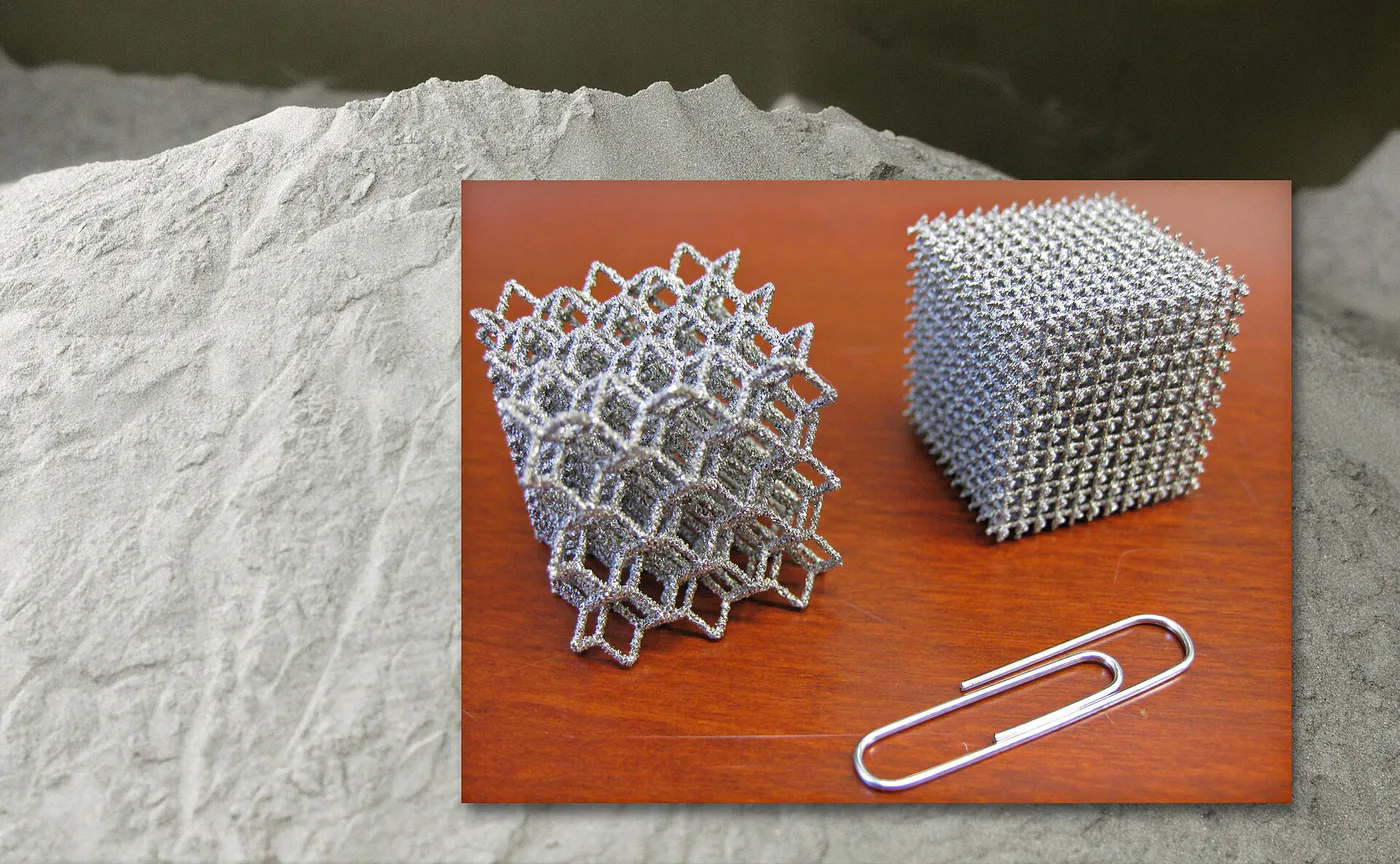
Eplus3D, Rosswag Engineering and qualloy launched the Eplus3D select material range on 9 November. Its first powders are 316L austenitic stainless steel and precipitation-hardening 17-4PH. The novelty is not a new alloy but a defined supply and validation chain: qualloy supplies powder, Eplus3D Germany builds references on an EP-M300, Rosswag performs tensile testing, and qualloy sells from German stock. The public data provide a useful starting point, not universal qualification for every part, machine and heat-treatment condition.
What did the partners validate?
The release identifies 50-micrometre layers on an EP-M300. It reports measured density above 99.9% for both alloys and evaluation of walls down to 0.5 millimetres and 35-degree overhangs. Tensile samples were tested in XY and Z. This connects powder lot, machine, parameter set and mechanical coupon, which is more informative than a generic alloy datasheet.
For 316L in XY, the table gives elastic modulus 166 ± 15 GPa, 0.2% proof strength 531 ± 15 MPa, ultimate strength 664 ± 15 MPa and A5 elongation 41 ± 5%. Z values are 149 ± 10 GPa, 452 ± 10 MPa, 585 ± 15 MPa and 51 ± 5%. For 17-4PH, XY values are 151 ± 12 GPa, 464 ± 10 MPa, 957 ± 10 MPa and 29 ± 5%; Z values are 168 ± 5 GPa, 575 ± 12 MPa, 980 ± 10 MPa and 26 ± 5%.
Why density above 99.9% is not enough
Relative density does not describe defect shape, position or orientation. At the same average porosity, a spherical gas pore and a planar lack-of-fusion flaw affect fatigue differently. The release shows a micrograph and downskin analysis but does not publish the complete CT dataset, sample count, confidence intervals or fatigue curves. A 35-degree overhang and 0.5-millimetre wall are manufacturability signals, not automatic dimensional or surface-tolerance guarantees.
Mechanical values also apply only to the reported condition. Heat treatment strongly affects 17-4PH, while texture, thermal history and pore population shape 316L behaviour. The public release does not fully document heat treatment and specimen preparation. A buyer therefore needs the exact condition alongside certificate and parameter identifier.
XY–Z differences carry useful information
The table shows orientation dependence. The 316L Z samples have lower proof and ultimate strength but higher elongation, while the reported 17-4PH Z proof strength is higher. This is not a simple pass or fail. Build orientation, contour, scan strategy, heat extraction and post-processing act together. Qualification needs coupons that represent critical loading directions rather than selection of the most attractive number.
What can an Eplus3D user gain?
Promised delivery from German stock within two to five working days could reduce procurement time. Existing Eplus3D users may need fewer initial experiments because reference data already exist for the powder-machine pairing. That does not eliminate incoming inspection, local machine-state checks or part-specific qualification. The partners claim reduced additional work, not automatic release of critical parts without verification.
Scope of the vendor evidence
All stages belong to one commercial ecosystem. Dividing supply, printing and testing is stronger than a single vendor datasheet, but it is not an independent round robin. The table does not replace raw reports, lot certificates, calibration, coupon placement, heat-treatment records or the test laboratory's accredited scope. A critical contract should request those documents.
Editorial conclusion
Eplus3D select is more consequential than two new store listings because it attaches powder procurement to a named machine, parameter and test package. That may reduce adoption friction and improve change traceability. Industrial value is demonstrated when a customer reproduces properties on its own machine, across representative positions and part geometry, then maintains them through new lots and controlled changes.
Sources and transparency
Eplus3D's release is the primary source for dates, machine, layer thickness, density, geometry and tensile data. The partner chain generated the data; the public source does not report independent multi-machine replication. ISO/ASTM 52907 and ASTM F3049 provide powder-characterisation context but do not certify this product.