MatterWave applies mechanical waves during LPBF solidification
Daedalus excites the build plate; the reported 10× fatigue life still lacks a public full protocol and independent replication.
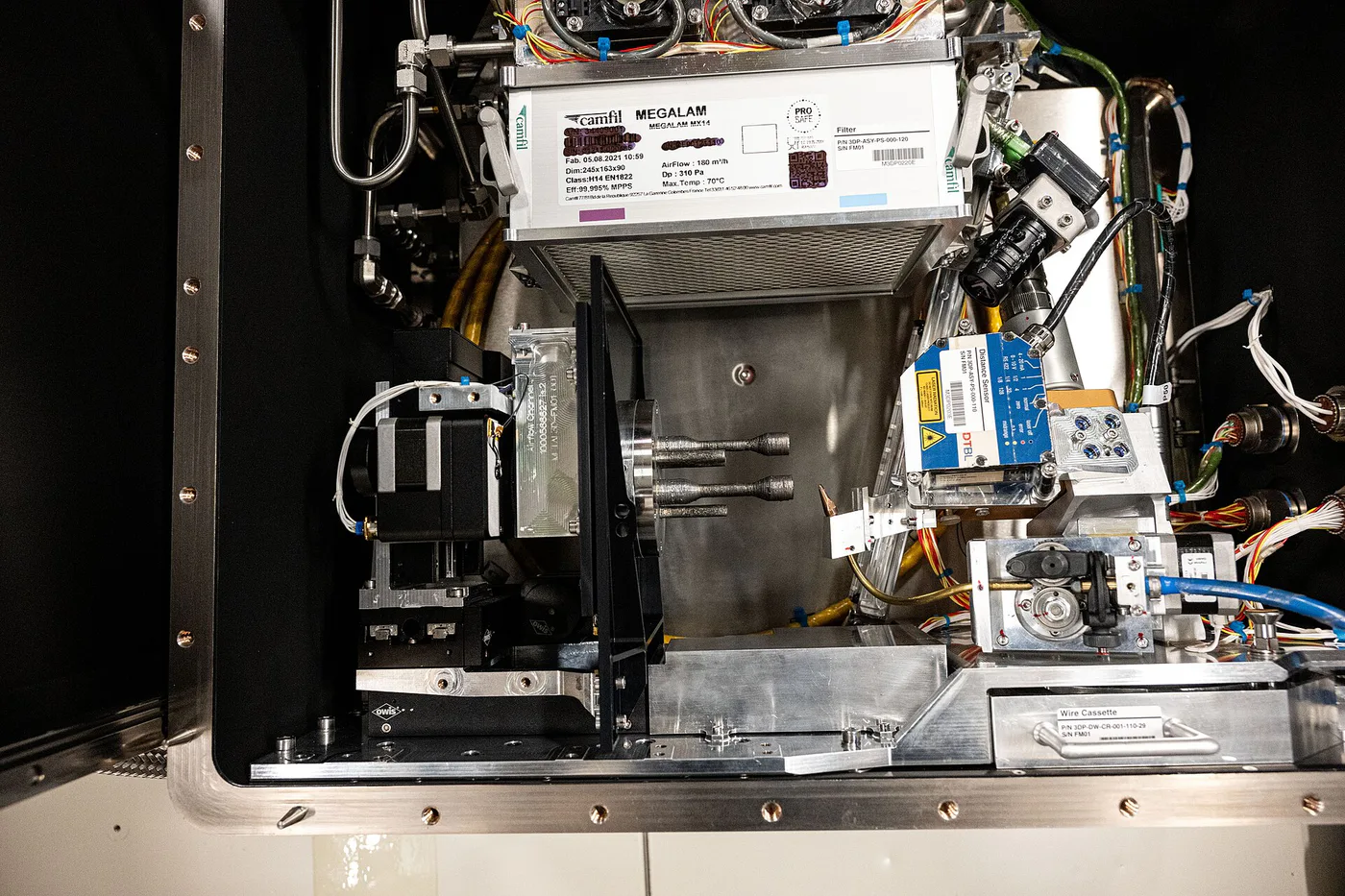
US startup MatterWave is developing Daedalus, a module that sends mechanical waves through an LPBF build plate while laser-melted metal solidifies. Its objective is to influence crystallisation and residual stress during the build rather than treating their consequences afterwards. MatterWave won SME's 2026 AM Start-Up Technology Award for a submission titled “Improving Durability and Consistency in Metal Additive Manufacturing.” A trade interview published on 5 November describes a retrofit prototype on an EOS M 290 and reports up to tenfold fatigue life, but the full test protocol and an independent replication are not public.
Where Daedalus intervenes
In LPBF, the laser heats a small volume rapidly and surrounding powder and solid metal remove heat just as quickly. Repeated thermal cycles can create steep gradients, plastic strain and residual stress. The consequences can include distortion, cracking during the build, movement after plate removal and scatter in fatigue performance.
MatterWave says an actuator coupled to the plate sends tuned mechanical waves into the solidifying region. The concept assumes that suitable frequency, amplitude and timing can influence nucleation, dendritic growth or the accumulation of stress. This differs from post-build vibratory stress relief because excitation occurs concurrently with laser processing.
What the public evidence establishes
SME's official 2026 award list names MatterWave and founder and CEO Alex Tilita as the startup-technology winner. The 3Dnatives interview describes a prototype installed on an EOS M 290, tunable excitation and a retrofit route for existing machines. These sources establish that the development and award are real.
The tenfold fatigue-life figure, improved consistency and easier processing of additional alloys remain company claims. The public material does not disclose the alloy, coupon geometry, surface state, heat treatment, load ratio, sample count, scatter or full control parameters. The number must not be treated as a universal multiplier for every LPBF part.
Retrofit opportunity and integration risk
A plate-coupled module could in principle work with multiple installed machine types without redesigning laser optics or powder handling. That could shorten adoption compared with a new printer platform. Actual compatibility, however, will depend on machine, plate, fixture and part configuration.
Vibration does not automatically remain in the intended region. The frame, recoater, powder bed, plate thickness, supports and the growing part's resonances all alter energy transmission. A setting useful for a short coupon can produce a different response in a tall thin wall. Excitation must not degrade powder-bed flatness, layer thickness, laser positioning or machine safety.
Evidence that would separate effect from demonstration
The next meaningful step is a pre-defined paired experiment on the same machine with the same powder lot, geometry and heat treatment. Excited and control builds should be compared across plate positions and repeated builds. Residual stress should be measured with at least two methods having different sensitivities, such as X-ray diffraction and post-release distortion; contour or neutron measurements may be justified for critical development.
Microstructure needs grain size, texture, porosity and crack characterisation. Mechanical evidence requires tensile, fracture and fatigue tests with surface state and machining recorded. Process evidence also includes accelerometer calibration, a frequency-transfer map and proof that each build received the intended excitation.
Editorial conclusion
MatterWave adds a potentially useful control variable to scan strategy, preheating and post-build heat treatment: deliberately applied mechanical energy. The award and working retrofit are credible development milestones. Industrial significance requires disclosed test boundaries, reproduction across geometries and materials, and proof that wave input does not introduce new powder-bed or machine-dynamic defects.
Sources and transparency
SME's official list is the primary source for the award and submission title. Technology details and performance figures come from a 3Dnatives interview with MatterWave's chief executive; no independent peer-reviewed Daedalus dataset was available at publication. NIST measurement research and a 2026 open review support the residual-stress context.