Pulsed-heat WAAM builds metre-scale titanium single crystals
DSP-WAAM maintained Ti-6Al-4V orientation from a polycrystalline substrate to metre scale without a prefabricated single-crystal seed.
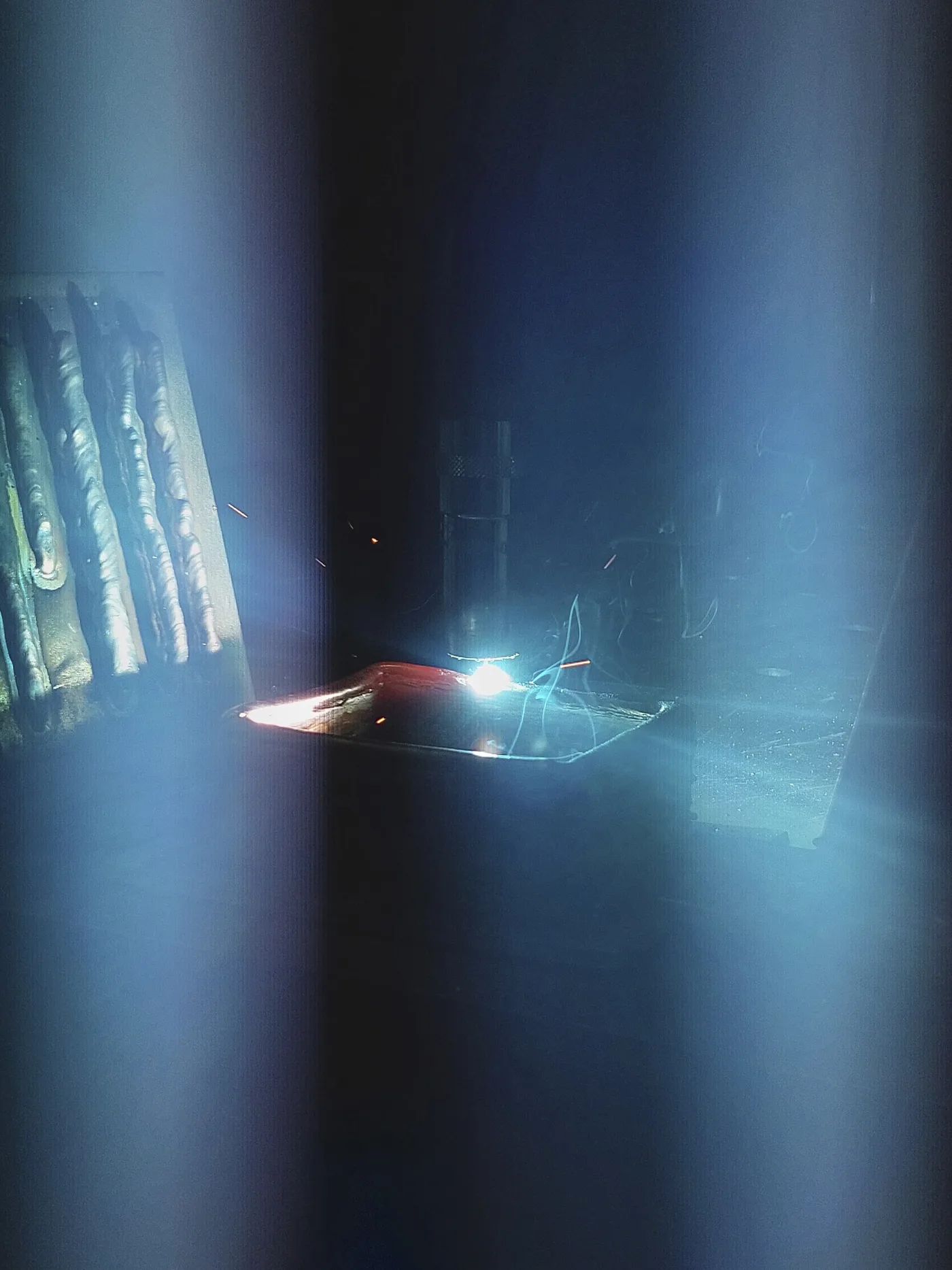
A team led by Beijing Institute of Technology has built metre-tall, centimetre-diameter Ti-6Al-4V single crystals using wire-arc additive manufacturing. Its Nature paper describes dynamic switched-power WAAM, or DSP-WAAM: alternating strong and weak heat-input pulses shape melting and solidification so that a favourable crystal orientation can persist. The authors report starting from a polycrystalline substrate without a prefabricated single-crystal seed. A 6 November notice from the National Natural Science Foundation of China returned the 21 October paper to the current institutional radar.
What is the demonstrated advance?
The peer-reviewed work shows more than a long column. The researchers produced metre-scale Ti-6Al-4V bodies that maintained a single orientation and support-free zigzag lattice structures. They also demonstrated the approach in tungsten, molybdenum, niobium and molybdenum–niobium systems. Conventional cast single crystals are constrained by seed, thermal gradient and mould. An additive path could provide more freedom, provided orientation remains continuous through every turn and thermal transition.
How DSP-WAAM works
In wire-arc DED, heat source and feedstock create a melt pool governed by current, voltage, wire feed, travel speed, interpass temperature and heat extraction. DSP-WAAM adds time-varying high and low power. The authors combine a thermo-mechanical and solidification model with melt-pool shape, thermal gradient and crystal-growth conditions, then use a printability phase map to select an operating region.
The objective is not simply to remelt every layer. Suitably oriented material in the preceding layer provides an epitaxial growth surface, while the pulsed cycle limits unwanted nucleation and grain competition. Orientation can therefore follow the toolpath. The balance is narrow: insufficient heat risks lack of fusion; excessive heat can destabilise the pool, promote evaporation or create competing orientations.
Starting without a prepared seed
The institutional account says growth began on a polycrystalline substrate rather than a manufactured single-crystal seed. That does not mean every setup automatically becomes a single crystal. Grain competition and heat flow select a favourable orientation during the early build, and subsequent layers must preserve it. The value lies in process-driven selection, but the mechanism still requires replication across machines, geometries and feedstock lots.
Mechanical result and its boundary
The paper highlights creep resistance in Ti-6Al-4V and reports an order-of-magnitude improvement relative to conventional grain-size scaling predictions. This must not be translated into a universal tenfold advantage over every forged or cast titanium product at every temperature and load direction. A single crystal is anisotropic: crystallographic orientation relative to stress governs slip, elasticity, creep and crack initiation.
The evidence remains at research scale. It does not establish aerospace approval, industrial part qualification, multi-machine capability or production economics. Metre scale is a substantial demonstration, but series manufacture would also require spatial orientation mapping, internal-defect control, chemistry, residual stress, surface and machining controls, and statistically supported long-duration properties.
Why the zigzag lattice matters
The support-free zigzag indicates that growth is not restricted to a straight vertical column. The engineering question is whether orientation and defect level survive direction changes, nodes and heat-accumulation zones. The lattice is therefore more than a visual demonstration: it is a harder test of thermal history and epitaxial continuity. Published orientation and microstructure evidence supports the result, while fatigue and damage tolerance remain separate qualification tasks.
Editorial conclusion
DSP-WAAM's important proposition is not that a single crystal improves every metal part. It is that time-domain control of solidification may open new geometric freedom for single-crystal manufacture. The Nature paper and institutional records establish a credible research milestone. Industrial significance requires independent replication, multiple machines and scales, lot-by-lot verification of orientation and defects, and statistically stable properties for the intended load case.
Sources and transparency
The primary evidence is the peer-reviewed Nature article and its supplementary material. Beijing Institute of Technology provides an institutional account of the method and team, while the National Natural Science Foundation of China's 6 November notice is the fresh institutional signal. Performance figures are research results; the sources do not report an independently qualified industrial process or commercial machine.