Open print3d agent turns ideas and photos into local 3MF projects
The plug-in writes Blender code and slices in Bambu Studio, but a human starts the print; generated code and manufacturability remain gates.
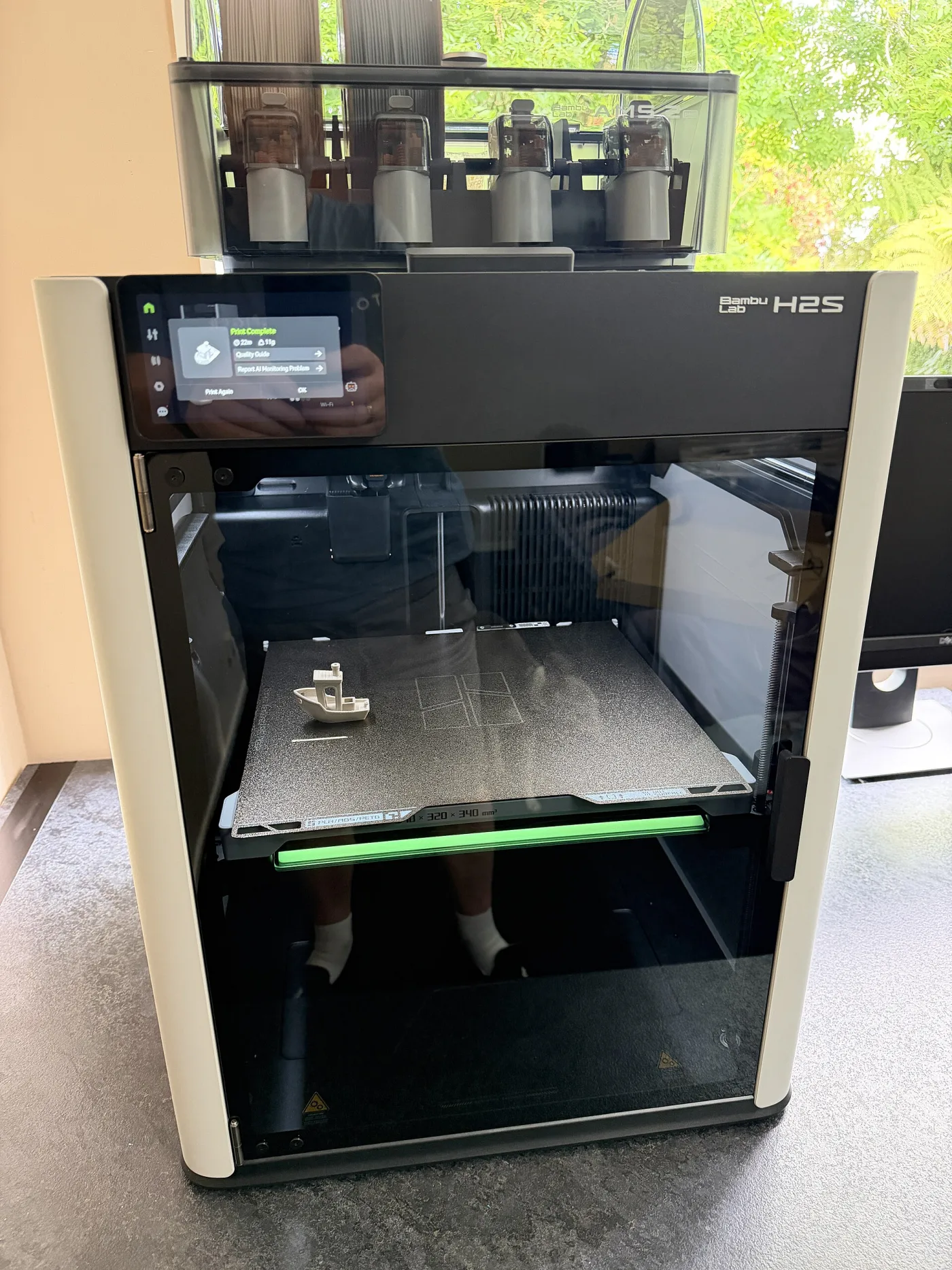
print3d is an MIT-licensed open project that lets an agent start from a text idea, photograph or product listing, write a Blender program, inspect the mesh, slice in Bambu Studio and prepare a 3MF project. It supports Hermes, Claude Code, Codex, Cursor and Gemini CLI. The workflow stops at the file: it does not automatically submit a job to the printer.
What happens behind the scenes?
The agent first tries to gather requirements and dimensions, then generates Python for Blender. That script creates or modifies geometry, after which the workflow requests mesh checks and Bambu Studio slicing. The output is a local 3MF that the user opens, reviews and starts manually.
The current profile is narrower than the label
Public instructions require Blender 4.2 or newer, Bambu Studio and the uv package manager. The default target is a Bambu Lab X2D with a 0.4 mm nozzle. This is a runnable reference, not proof of printer-independent compatibility. Other machines, nozzles, materials and chambers need their own profile and regression.
Demonstrations are useful, not benchmarks
A clothes-peg example uses a 115 mm reference and reports a 114.9 mm model, 49-minute estimate and 7.2 g of material. Another example approximates a bracket from a photograph. These are documented demonstrations, not representative test series. One overall dimension does not establish spring force, surface deviation or repeatability, and a PLA bracket is not automatically a load-bearing replacement.
The reference establishes scale
Perspective does not reveal absolute size, so print3d asks for a known-size reference. One line establishes scale but does not correct lens distortion, hidden geometry or plane angles. A fitting part needs several dimensions, the mating component and a low-cost physical coupon.
Security boundary: generated code runs locally
Blender Python runs with the user's permissions, and the documentation warns that a child process may operate outside an agent terminal sandbox. This is a stronger risk than opening a passive mesh. Treat unknown descriptions, web pages and tools as untrusted input; review generated code, use an isolated environment, and withhold secrets and writable production directories.
Privacy and network boundary
The project says jobs, photos and slicing stay local and that it has no telemetry. It can still download dependencies, and its viewer may use an external three.js CDN. The selected AI agent's own service and data path remain a separate question: a local plugin does not prove that every prompt and image stays local.
Human gates before printing
Review source rights, nominal dimensions, wall thickness, closed volume, orientation, support, material, profile identity, layer preview and estimated mass. Functional parts need fit coupons, load limits and failure-mode review. The agent can accelerate modelling and preparation; it cannot transfer accountability to software.
Editorial conclusion
print3d is an inspectable open integration with code, workflow and concrete 3MF output. Its main value is reducing tool hand-offs. Its main risk comes from the same feature: natural language becomes executable code and a manufacturing file. Safe use needs a machine-specific profile, code approval, slicer regression and physical trials.
Sources and transparency
Features, requirements, examples and security warnings come from the project's GitHub repository. The code is open under MIT, but there is no independent accuracy, security or multi-printer benchmark; the examples are developer demonstrations.